Korean culture
Hanbok: the parts, the colours and what they meant
한복 (韓服)
A short tied jacket over a skirt or trousers, traced back to Goguryeo tomb murals. What each part is called, how the jacket shrank, what the trim signalled, and the dress rules for free palace entry.
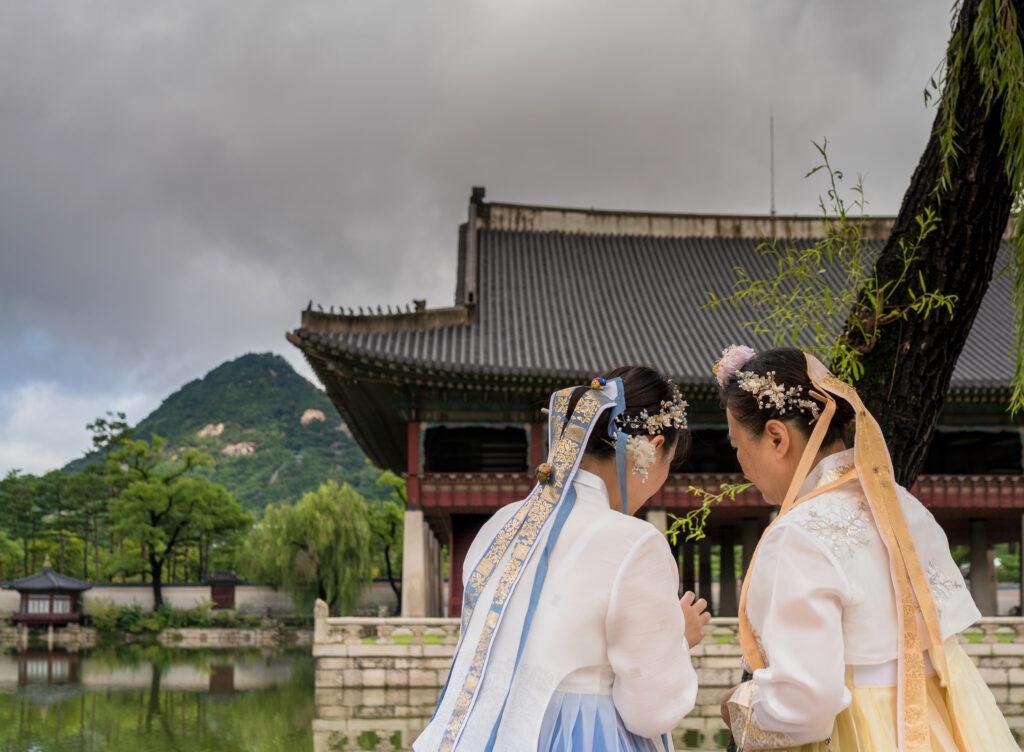
A hanbok is Korean traditional dress: a short jacket, the jeogori, worn over a long skirt, the chima, or over roomy trousers, the baji, with a long coat, the po or durumagi, on top. Its basic shape already appears in Goguryeo tomb murals of the fourth to sixth centuries, and Koreans still wear it for weddings and holidays.
What is a traditional hanbok?
The Encyclopedia of Korean Culture traces the basic outfit to the clothing of the northern steppe peoples, and dates the earliest clear evidence to the Goguryeo tomb murals and to finds from Silla and Baekje. The early jacket had the marks of that northern dress: a straight collar, narrow sleeves, and a front that closed to the left.
- Korean name
- Hanbok (한복, 韓服)
- The jacket
- Jeogori (저고리)
- The skirt
- Chima (치마)
- The trousers
- Baji (바지)
- The ties
- Goreum (고름)
- Earliest evidence
- Goguryeo tomb murals, 4th to 6th century
- National heritage
- Hanbok saenghwal, designated 20 July 2022
- Hanbok Day
- 21 October, designated in 1996
The parts of a hanbok
- Jeogori (저고리). The jacket, worn by men and women. The encyclopedia lists its basic parts as the body, sleeves, collar, dongjeong and goreum.
- Chima (치마). The woman’s long skirt.
- Baji (바지). The man’s trousers.
- Po (포) and durumagi (두루마기). Long outer coats. The Victoria and Albert Museum notes that long coats appear from the sixth century and stayed in use for more than a thousand years.
- Goreum (고름). The ribbon ties that close the jacket at the front in a single-loop bow, in place of buttons.
- Dongjeong (동정). The narrow white band along the collar.
- Norigae (노리개). A hanging ornament, hooked onto the goreum or the waistband of the skirt, according to the Korea Cultural Heritage Foundation.
The goreum caught the eye of early Western visitors. The National Folk Museum of Korea quotes the American astronomer Percival Lowell, in Korea in 1883, calling the tied closing artistic and remarking on the white dongjeong against the curved collar.
History of hanbok: the jacket that kept shrinking
The women’s jeogori is the clearest record of changing fashion. The Encyclopedia of Korean Culture gives these lengths:
| Century | Typical women’s jeogori length |
|---|---|
| 1600s | 60 to 80 cm |
| 1700s | about 45 cm |
| 1800s | about 35 cm |
| 1900s | about 22 cm |
Not everyone approved. The National Folk Museum cites a late Joseon scholar who called the short jacket bewitching and wanted it banned outright. The same short jacket is now valued as traditional dress.
Hanbok colours and their meaning
The Victoria and Albert Museum links the everyday white hanbok of most Joseon people to a neo-Confucian taste for austerity, while court officials and royalty wore strong reds, blues, greens and black. Colour on a woman’s jacket carried its own signals. The most formal type, the samhoejang jeogori (삼회장저고리), has trim in a contrasting colour at the collar, the cuffs and the underarms; the encyclopedia notes it was made in fine silks, usually trimmed in purple or red.
Trim of this kind was tied to a woman’s family situation. The Korean culture paper Uri Munhwa Sinmun describes yellow or light green jackets with purple or indigo trim, and says a woman with children and a living husband could wear a trimmed jeogori even at seventy.
For marital status the clearest marker was hair rather than colour. The V&A describes unmarried young people wearing their hair braided and tied with a ribbon, and married men tying their hair into a topknot, the sangtu.
When hanbok is worn in Korea today
On 20 July 2022 the Cultural Heritage Administration, now the Korea Heritage Service, designated hanbok saenghwal (한복생활), the custom of wearing hanbok, as a National Intangible Cultural Heritage. The listing names the occasions: holidays such as Chuseok, a child’s first birthday, weddings and ancestral rites. It has no individual holder, because the practice belongs to the whole community. The Seoul Shinmun linked the timing to anger over hanbok appearing in the opening ceremony of the Beijing Winter Olympics that February.
The National Folk Museum also points to newer forms, from reworked hanbok to casual everyday versions with modern sleeves, buckles and lace.
Free palace entry in hanbok
Since 2013 the heritage authorities have let visitors in hanbok into Seoul’s four main palaces, Gyeongbokgung, Changdeokgung, Changgyeonggung and Deoksugung, and into Jongmyo Shrine and a number of royal tombs, without paying. The Asia Business Daily reported in May 2026 that the number of free hanbok visitors had grown from 300,000 to 400,000 a year at the start to more than two million.
The criteria cover the outfit itself. It needs a top and a bottom: a jeogori with an overlapping collar, over a separate skirt or trousers. A jeogori with jeans does not count, nor does a hanbok skirt with a T-shirt, a one-piece robe such as a cheollik worn on its own, or a jeogori cut so short that it exposes the chest. Since July 2019, after a recommendation from the National Human Rights Commission, men may enter in women’s hanbok and women in men’s.
Questions people ask
What does the word hanbok mean? Korean clothes. The V&A notes that the term came into use in the late nineteenth century to set Korean dress apart from Western clothing.
How is a hanbok different from a kimono? A hanbok is two pieces, a jacket over a separate skirt or trousers, closed with ribbon ties. Britannica describes the kimono as an ankle-length gown lapped left over right and held at the waist with a broad sash, the obi. There is more on the Japanese garment in our guide to kimono and yukata.
When is Hanbok Day? 21 October. It was designated in 1996 to get hanbok worn more widely, at home and abroad.
