Korean culture
Pansori and talchum: Korea’s sung stories and masked satire
판소리 · 탈춤
One singer and a drummer carrying a story for hours, and masked satire played in any open space. How pansori and talchum work, what survives, and where to see them.
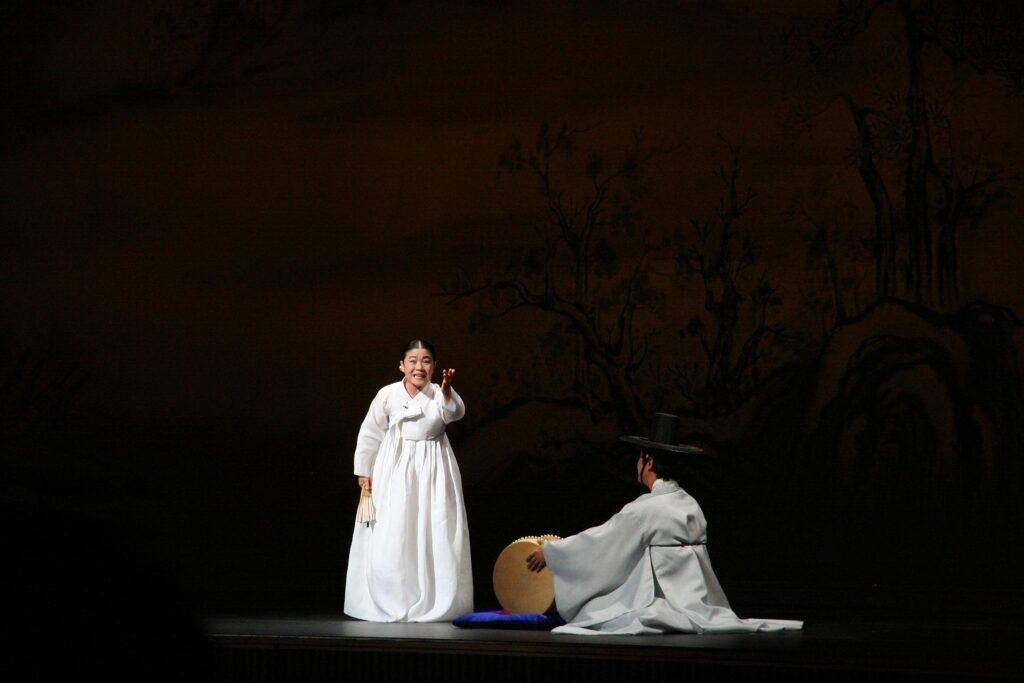
Pansori is Korean sung storytelling: one singer, one drummer and a single story that can last for hours. Talchum is masked dance drama, played in any open space with a band of musicians, in which stock characters ridicule aristocrats and wayward monks. UNESCO recognised pansori in 2003 and talchum in 2022.
Pansori and talchum side by side
| Pansori (판소리) | Talchum (탈춤) | |
|---|---|---|
| Who performs | One singer, the sorikkun, and one drummer, the gosu | Masked performers with six to ten musicians |
| Where | Wherever a crowd gathers; the name joins pan, a gathering place, and sori, song | Any empty space; no formal stage is needed |
| Length | Up to eight hours for a complete story | A chain of separate scenes, called madang |
| Subject | Five surviving stories of love, filial duty, greed and war | Satire of the upper class, of monks and of the patriarchal household |
| The audience | Calls out encouragement, chuimsae | Cheers and jeers as the scenes go on |
| Protected in Korea | National Intangible Cultural Heritage since 1964 | Thirteen forms at national level, five at city or provincial level |
| UNESCO | Proclaimed 2003, on the Representative List since 2008 | Inscribed 30 November 2022 |
What is pansori?
UNESCO describes pansori as musical storytelling by a vocalist and a drummer. The singer, the sorikkun (소리꾼), carries the whole story alone: the sung passages, the spoken narration called aniri (아니리), and the gestures called ballim (발림) that act out each character in turn.
The drummer is the gosu (고수, 鼓手). He sits beside the singer with a barrel drum, the soribuk, keeps the rhythmic cycles steady and calls out chuimsae (추임새), short shouts such as jalhanda, “well done”, or geureochi, “that’s it”, which lift the singer at the right moment. The National Gugak Center counts these calls as part of the form, and listeners who know pansori make them too.
Korean has a saying for the balance between the two: il-gosu i-myeongchang (一鼓手二名唱), first the drummer, second the master singer. The Encyclopedia of Korean Culture records a harsher one: a boy can become a master singer, but there is no such thing as a boy master drummer.
The pansori singer and the full performance
According to UNESCO, a complete performance can run up to eight hours, and singers train for years to master the range of vocal timbres the form demands while memorising a large repertory. Singing an entire story in one sitting has its own name, wanchang (완창). The National Theater of Korea started a wanchang series in 1984, and by its fortieth year a hundred singers had performed in it.
Two broad schools developed. The National Gugak Center describes Dongpyeonje as the plainer, more forceful style, and Seopyeonje as the more ornamented one, built on the plaintive gyemyeon mode.
The five pansori stories still sung
There were once twelve story cycles, or madang. Five are still performed:
- Chunhyangga (춘향가). A gisaeng’s daughter secretly marries a magistrate’s son and holds out against a corrupt official until her husband returns as a royal inspector.
- Simcheongga (심청가). A daughter gives herself to the sea to pay off her blind father’s debt; the two are reunited and he recovers his sight.
- Heungboga (흥보가). A poor, kind brother nurses a wounded swallow and is rewarded with treasure. His greedy brother tries the same and comes to grief.
- Sugungga (수궁가). The ailing Dragon King needs a rabbit’s liver, and a terrapin volunteers to fetch one from dry land.
- Jeokbyeokga (적벽가). The Battle of the Red Cliffs, taken from the Chinese novel Romance of the Three Kingdoms.
Where pansori came from
UNESCO places its emergence in south-west Korea in the seventeenth century, probably out of the narrative songs of shamans. The National Gugak Center describes a simpler song form, known under names such as taryeong, that lasted into the eighteenth century. In the late eighteenth century new rhythms, new vocal techniques and the singers’ own signature passages turned it into an art music.
South Korea designated pansori a National Intangible Cultural Heritage in 1964. UNESCO proclaimed it a Masterpiece of the Oral and Intangible Heritage of Humanity in 2003 and carried it onto the Representative List in 2008. The UNESCO file is frank about one side effect of protection: as written texts became fixed, much of the improvisation singers once relied on was lost.
What is talchum?
Talchum is Korean mask dance drama; tal means mask and chum means dance. UNESCO’s description treats it as dance, music and theatre at once: masked performers, six to ten musicians, and no need for a stage, because any open space can serve. The characters are caricatures of familiar types, and the plays turn on criticism of social hierarchy and an appeal to equality. The crowd is expected to respond out loud.
UNESCO inscribed “Talchum, mask dance drama in the Republic of Korea” on 30 November 2022, at the committee’s seventeenth session in Rabat. The listing covers eighteen regional forms, thirteen designated at national level and five at city or provincial level. The Korea Times summed up their content as ridicule of the upper-class elite, the absurdities of a patriarchal pre-modern society, and the joys and sorrows of ordinary people. It was Korea’s 22nd element on the UNESCO list.
Talchum masks and the regional plays
Each regional play has its own masks and its own cast. Near Andong, the wooden Hahoe masks belong to Hahoe byeolsingut talnori, a play once staged for the village’s guardian deity and designated National Intangible Cultural Heritage in 1980. That page covers the masks and the play in detail.
In Gangneung, on the east coast, the gwanno mask drama has no dialogue at all. The government broadcaster KTV calls it the only traditional mask play carried entirely by dance and gesture, with an emphasis on festivity and prayers for good harvests and catches rather than sharp satire.
Where to see pansori and talchum
For a complete pansori, the National Theater of Korea’s wanchang series in Seoul is the long-running choice. For talchum, the Andong Mask Dance Festival runs for ten days from the last Friday of September to the first Sunday of October, with venues including the city’s Talchum Park, according to Andong’s tourism office. Hahoe village itself has a regular programme of performances by the Hahoe byeolsingut talnori preservation society.
Pansori has also reached people who have never sat through a wanchang. In 2020 the Korea Tourism Organization’s “Feel the Rhythm of Korea” videos paired the band Leenalchi, whose four vocalists sing in pansori style, with the Ambiguous Dance Company. The Korea Herald later reported some 80 million YouTube views for the series.
Questions people ask
What does pansori mean? Pan is a place where people gather and sori is song or sound, so the word describes singing to a crowd.
Can you shout during a pansori? Calls of encouragement are part of the form, not an interruption. The gosu leads them, and the Encyclopedia of Korean Culture credits him with steering the mood between singer and audience.
How long is a pansori performance? A whole story can take up to eight hours, which is why a complete performance is billed separately as wanchang.