
Korean culture
Oppa: what it means, and who is allowed to say it
오빠
Older brother, said only by a girl or woman. How it differs from hyung, noona and unnie, why many Korean women call an older boyfriend oppa, and what Psy meant by Oppan Gangnam Style.
Oppa (오빠) means older brother, and only women and girls say it. The National Institute of Korean Language gives it two senses: a girl’s older brother or male cousin, and any older man she addresses warmly. A man uses hyung for the same relationship. In South Korea many women also call an older boyfriend oppa.
Oppa vs hyung, noona and unnie
Korean chooses the word for an older sibling by the speaker’s sex as well as the older person’s. That gives four words where English has two, and the pair a learner meets first, oppa and hyung, both translate as older brother.
| Said by a woman | Said by a man | |
|---|---|---|
| To an older man | Oppa (오빠) | Hyung (형) |
| To an older woman | Eonni, often spelt unnie (언니) | Nuna, often spelt noona (누나) |
So one man can be oppa to his sister and hyung to his brother at the same table. The word describes the relationship from the speaker’s side, not anything about him. Each has a more formal form: a woman can say orabeoni or orabeonim instead of oppa, and a man hyeongnim instead of hyung.
- In Hangul
- 오빠
- Means
- Older brother
- Said by
- Girls and women, to an older man
- A man says instead
- Hyung (형)
- Older woman
- Eonni or unnie from a woman, nuna or noona from a man
- More formal form
- Orabeoni, orabeonim
- Also used for
- Older male friends, boyfriends and husbands
- In English dictionaries
- Oxford English Dictionary since 2021
Oppa outside the family
None of the four is limited to relatives. They are used for older friends, classmates and colleagues, because polite Korean avoids the second-person pronoun and uses kinship terms, titles or names in its place. The learners’ dictionary of the National Institute of Korean Language defines the second sense of oppa as a word a girl uses endearingly for another male who is older than she is. Warmth is part of the definition, which is why the word sits oddly in the mouth of a stranger.
Who counts as older is not a matter of feel. Honorific choice in both Koreas turns on whether the other person was born in an earlier year, the same year or a later one, and asking a new acquaintance’s age is common. Since 28 June 2023 South Korea has used international age on official documents, but the habit of sorting people by birth year did not change with it.
The wider use is fairly recent. Until the early 1990s, women at Korean universities often called male seniors hyung, the same word the men used. A 1990 entrant told the Chosun Ilbo that by around 1993 or 1994 female students had clearly switched to oppa, and fan clubs for idol singers and college basketball players spread the word further in the same decade.
Oppa meaning boyfriend: do women in Korea call their partners oppa?
Yes, often, when the man is older, and many carry on after marriage. A survey of 1,603 married people in their 30s to 50s, run by the SM C&C platform Tillion Pro on 19 and 20 October 2024 and reported by the Chosun Ilbo, found that 37.7 per cent of wives in their 30s called their husband oppa, 26.2 per cent in their 40s and 9.4 per cent in their 50s. Yeobo, roughly darling, was the main alternative.
The official guidance points the other way. The address guides the National Institute of Korean Language produced with the Chosun Ilbo, in 1992, 2011 and 2020, advise wives not to call their husbands oppa and suggest yeobo, or father of plus the child’s name once there are children.
What does Oppan Gangnam Style mean?
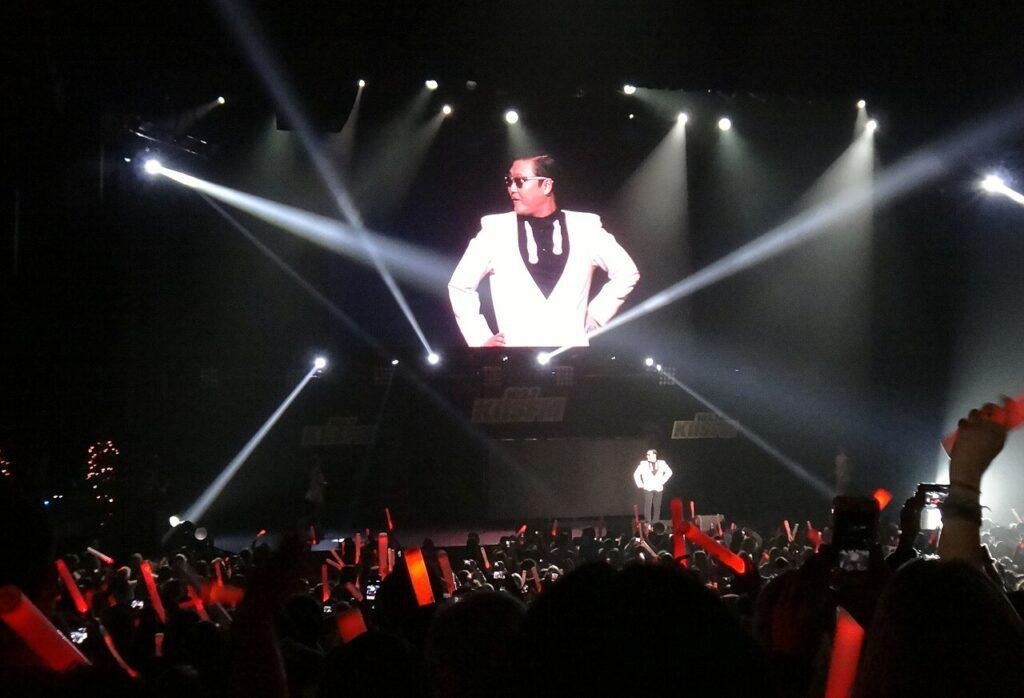
Oppan is oppa with the particle -neun (는) shortened onto it, so the refrain of Psy’s 2012 hit, 오빤 강남스타일, reads as big brother is Gangnam style, with Psy talking about himself. Gangnam style was a coinage for the nouveau riche lifestyle associated with Seoul’s Gangnam district. The song came out on 15 July 2012, and on 21 December 2012 its video became the first on YouTube to pass a billion views. In 2021 oppa entered the Oxford English Dictionary.
Polite alternatives: -ssi, -nim and seonbae
-ssi is the everyday honorific between people of roughly equal standing, close to Mr or Ms. It follows a full name or a given name; attached to a surname alone it can sound rude, because it implies the speaker ranks higher.
-nim is the higher form, used for customers, guests and anyone senior, as in seonsaengnim for a teacher.
Seonbae is a senior at the same school, club or workplace, and hubae a junior. These follow the institution rather than age alone.
For someone you have just met, a name with -ssi or a job title with -nim is the safe choice. Oppa, in its second dictionary sense, is the affectionate one.
Questions people ask
Is oppa a Japanese word? No, it is Korean. In Hangul it is written 오빠, and oppa is its spelling in the official Revised Romanization.
Can a man say oppa? Not as the speaker. A man calls an older man hyung and an older woman nuna.
What is the female version of oppa? Eonni, often written unnie, is what a woman calls an older woman. The word a man uses for an older woman is nuna.
Does oppa mean daddy? No. Father is appa in everyday speech and abeoji in more formal speech; oppa only ever means an older brother or an older man addressed like one.
Why do K-pop fans say oppa? Fans use it for male idols in the affectionate sense of the word. The habit goes back at least to the oppa fan clubs of the 1990s, and fans of the Korean Wave abroad have taken it up for actors as well as singers.