
Philippines food
Halo-halo: what goes in it, and the order it goes in
halúhalò
Shaved ice over sweet beans, fruit and jellies, a crown of leche flan or ube, and evaporated milk poured on top. What goes in, the order it goes in, what the name means and where the dessert came from.
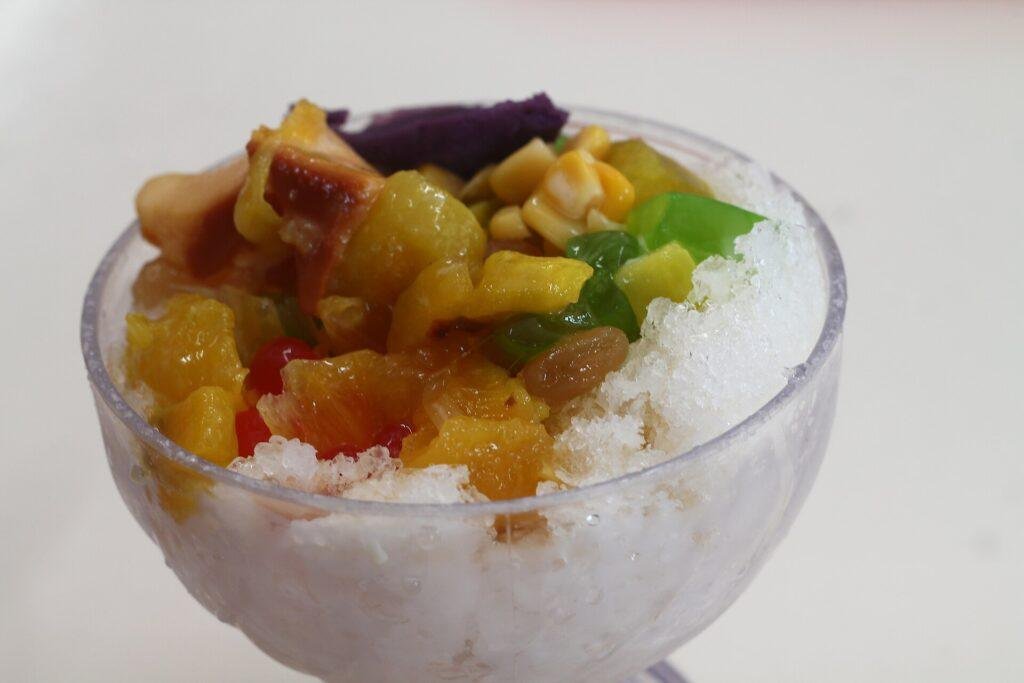
Halo-halo is a shaved-ice dessert from the Philippines, served in a tall glass: sweet beans, fruit and jellies at the bottom, shaved ice over them, leche flan, ube halaya or ice cream on top, and evaporated milk poured over as it is handed across the counter. The name means mixed together, and you stir it before eating.
What is in halo-halo, the shaved-ice dessert of the Philippines?
There is no fixed list. What turns up most often:
- Sweet beans. Sweetened kidney beans or garbanzo beans.
- Kaong. Sugar palm fruit.
- Macapuno. Coconut sport, a natural mutant coconut whose flesh is soft and jelly-like instead of firm.
- Saba bananas. Plantains cooked in syrup.
- Langka. Jackfruit.
- Kamote and ube. Sweet potato and purple yam, in syrup or as ube halaya, a sweet jam.
- Gulaman and sago. Agar jelly cubes and tapioca pearls.
- Pinipig. Pounded, toasted young rice, which gives the glass its crunch.
- Type
- Shaved-ice dessert
- Name means
- Mixed together
- Base
- Shaved ice over sweet beans, fruit and jellies
- Poured over
- Evaporated milk, sometimes coconut milk
- Toppings
- Leche flan, ube halaya, ice cream
- Traced to
- Pre-war Japanese Filipinos and kakigōri
The order it goes in
- Bottom. The sweetened fruit, beans and jellies.
- Middle. Shaved ice, packed into the glass.
- Top. Leche flan, ube halaya, ice cream, or any combination of the three.
- Last. Evaporated milk, or sometimes coconut milk, poured over as it is served.
The heavy ingredients go under the ice rather than over it, so the glass reaches you in layers and the mixing is left to the person eating it.
What does halo-halo mean?
The word comes from the Filipino verb halò, to mix. Doubled, it is an adjective meaning mixed together. It is often rendered in English as mix-mix, which copies the repetition and misses the sense. The Commission on the Filipino Language, in its official dictionary, prescribes the spelling halúhalò.
Where did halo-halo come from?
The line runs back to Japan. The dessert is traced to Japanese Filipinos before the Second World War and to kakigōri, the family of Japanese shaved-ice desserts.
An earlier local form was monggo con hielo: mung beans boiled in syrup and served on crushed ice with milk and sugar. It is halo-halo with two ingredients, and everything since has been addition.
Some writers go further and place the first halo-halo with Japanese migrants at the Quinta Market in Quiapo, Manila, in the 1920s or 1930s, close to the Insular Ice Plant that made ice available in quantity. That account comes from those writers rather than from a documented first sale, so treat it as a likely story, not a settled one.
| Kakigōri | Monggo con hielo | Halo-halo | |
|---|---|---|---|
| From | Japan | Philippines, pre-war | Philippines |
| Base | Shaved ice | Crushed ice | Shaved or crushed ice |
| What goes in | Flavouring | Sweet mung beans, milk, sugar | Several sweet ingredients, a topping and evaporated milk |
How to eat halo-halo
Stir it from the bottom until the layers are gone. The name is the instruction. Eaten in neat spoonfuls from the top, it is mostly ice and milk, with the beans and fruit waiting at the bottom.
Making halo-halo at home
Four or five of the ingredients above make a real glass; nobody needs all of them. Evaporated milk, which is unsweetened, is the usual pour, and the syrups on the fruit and beans already carry the sugar.
For a savoury Filipino dish to go with it, see our guide to chicken adobo.
Questions people ask
What does halo-halo mean? Mixed together, from the Filipino halò, to mix. Mix-mix is a common but loose translation.
Is halo-halo the national dessert of the Philippines? It is widely described as the unofficial national dessert, which is as far as its status goes.
What order do you put halo-halo in? Sweet ingredients at the bottom, shaved ice in the middle, leche flan, ube halaya or ice cream on top, and evaporated milk poured over last.
Do you stir halo-halo? Yes, thoroughly, before eating.
Where does halo-halo come from? It is traced to Japanese Filipinos before the war and to Japanese shaved ice, with monggo con hielo as its local forerunner.