
Korean food
Samgyetang: Korea’s Ginseng Chicken Soup for Fighting Summer Heat With Heat
삼계탕 · samgyetang
A whole young chicken simmered with ginseng, rice, and jujube until it falls apart — Korea's answer to summer heat, eaten hottest on the hottest days under the logic of "fighting heat with heat."
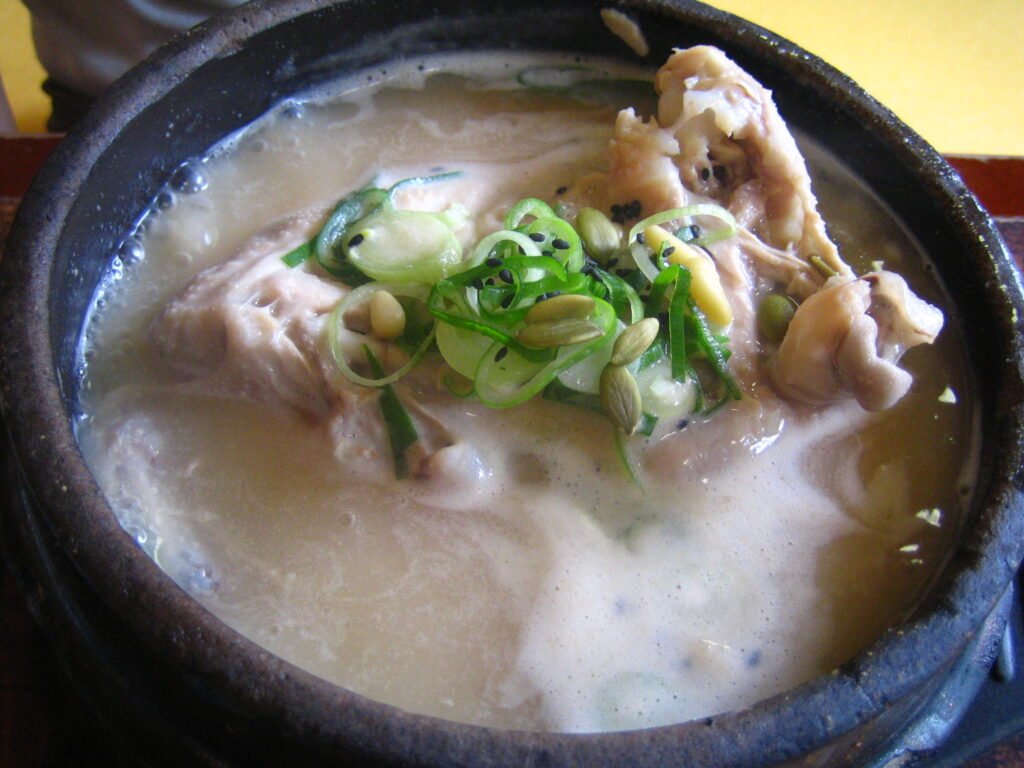
Samgyetang (삼계탕) is a Korean soup built around a whole young chicken stuffed with glutinous rice, ginseng, garlic, and jujube, then simmered until the broth turns milky and the meat slides off the bone. It arrives bubbling in an individual stone or ceramic bowl and is pulled apart at the table with a spoon and chopsticks, eaten as a restorative rather than a casual lunch.
What the name actually means
The name is a straightforward compound: sam (蔘) for ginseng, gye (鷄) for chicken, and tang (湯) for soup or stew. Interestingly, the dish was not always known in this order. Through the 1950s it circulated under the name gyesam-tang, putting chicken first and ginseng second. The name flipped to samgye-tang as ginseng’s role in the dish, and its medicinal reputation, took priority in how people talked about it. Both the Korean name and its Chinese equivalent, renshen jitang (人蔘雞湯), translate the same way: ginseng chicken soup.
- Korean name
- 삼계탕 (Samgyetang)
- Literal meaning
- sam (ginseng, 蔘) + gye (chicken, 鷄) + tang (soup, 湯)
- Main ingredients
- Whole young chicken, glutinous rice, ginseng, jujube, garlic
- Eaten on
- Boknal — chobok, jungbok, and malbok, the three hottest days of the Korean lunar summer
- Medicinal framing
- Iyeolchiyeol ("fight heat with heat"); ginseng valued as a stamina and vitality tonic
- Related dish
- Baeksuk, the plain ginseng-free chicken soup widely cited as its historical predecessor
Boknal: fighting heat with heat
Samgyetang’s strongest cultural association is with boknal (복날), the three hottest stretches of the Korean lunar summer: chobok, jungbok, and malbok, spaced roughly ten days apart across July and August. On these days, offices empty out early, restaurants post lines out the door, and ordering a whole bubbling chicken in 35-degree heat makes a kind of cultural sense that confuses most visitors on first contact.
The logic behind it is a folk health concept called iyeolchiyeol (이열치열), literally “fight heat with heat.” The idea holds that in hot weather, blood concentrates near the skin to cool the body, which can leave the stomach and digestive organs under-supplied and appetite and energy running low. Eating something hot and fortifying is meant to counteract that seasonal drain rather than add to it. It is the same instinct, inverted, that leads people elsewhere to reach for cold food in the heat; Koreans reach for a pot that is still boiling when it reaches the table.
From baeksuk to samgyetang: what the history actually supports
The documented history is older and plainer than the finished dish suggests. Plain whole chicken soup without ginseng, known as baeksuk (백숙), is the simpler, older dish most food historians point to as samgyetang’s direct ancestor, and versions of chicken soup made for elders and the unwell appear well back into the Joseon dynasty (1392–1897), alongside related dishes recorded under names like yeongye-tang and hwanggye-tang. One account from the Joseon court describes chicken boiled with milkvetch root being served to an ailing queen during King Injo’s reign.
The ginseng-stuffed version familiar today is a more recent layer on that older base. The 1917 cookbook Joseon Yorijaebeop describes a chicken gutted and stuffed with glutinous rice and ginseng powder, and later Korean food historians trace the dish’s shift into restaurant culture to roughly the 1940s, with the modern form, using whole ginseng root rather than powder, becoming practical only after refrigeration spread through Korea from the 1960s onward. Read generously, that makes today’s samgyetang a 20th-century refinement of a much older chicken-soup tradition rather than a single dish with one clean origin point.
That history has also become a point of friction. Chinese sources, including entries on Baidu, have described samgyetang as originating in Guangdong province and later spreading to Korea, a claim Korean commentators have pushed back on, pointing to Korea’s own longstanding chicken-soup customs and to samgyetang’s registered international product classification, which China does not hold for the dish. Neither side’s version is settled history; it is worth knowing the dispute exists rather than treating either claim as final.
Ginseng, stamina, and the body in summer
Ginseng sits at the center of the dish’s reputation as a tonic food. In Korean traditional thinking about food and the body, it is prized for supporting stamina and vitality, which lines up neatly with the boknal calendar: a season when appetite and energy are said to dip is treated as exactly the moment to eat something built to restore them. Jujube and garlic round out that same tonic logic, and the chicken itself, cooked whole and slowly, is meant to give back more than it costs to digest. None of this is framed in the soup’s own tradition as medicine in a clinical sense; it is closer to a seasonal maintenance ritual than a prescription.
Variants beyond the classic bowl
The base recipe has room for substitution. Some restaurants serve a black-skinned, black-boned chicken version, often listed simply as black chicken samgyetang, in place of the standard pale bird; the color comes from the chicken breed itself rather than any difference in cooking. A related black chicken ginseng soup tradition using silkie chickens is well documented on the Chinese side of this dish family, and Korean kitchens that serve the black-boned version draw on the same idea of a visibly different bird in an otherwise familiar bowl. Abalone turns up too: a number of Seoul restaurants add abalone to the pot under names like jeonbok samgyetang, treating the shellfish as a premium addition to the same stuffed-chicken formula rather than a separate dish.
Where tourists go to eat it
Tosokchon, a hanok-style restaurant near Gyeongbokgung Palace in Jongno-gu, is the name most visitors to Seoul end up with, open since 1983 and known for a broth thickened with pine nuts and mung beans into something richer and creamier than the clearer versions served elsewhere. It is not the only address worth knowing, but it is the one that shows up most consistently on lists aimed at first-time visitors, partly because it offers English menus and sits two minutes from a subway exit, and partly because complimentary ginseng liquor before the meal has become part of its own small ritual.
More Korean food on this site: for the wider context around dishes like this one, see our overview of Korean food culture. For a different kind of hearty, single-bowl soup with its own seasonal logic, read about yukgaejang, Korea’s spicy beef soup, which carries its own boknal associations alongside samgyetang’s.