
Korean food
Banchan: What Korean Side Dishes Are, and How Many You Get
반찬 · banchan
Banchan are the small shared side dishes that turn a bowl of plain rice into a full Korean meal. This guide covers what counts as banchan versus what doesn't, the old court rule that decided how many a table could hold, and why restaurants are now rethinking the free refill.
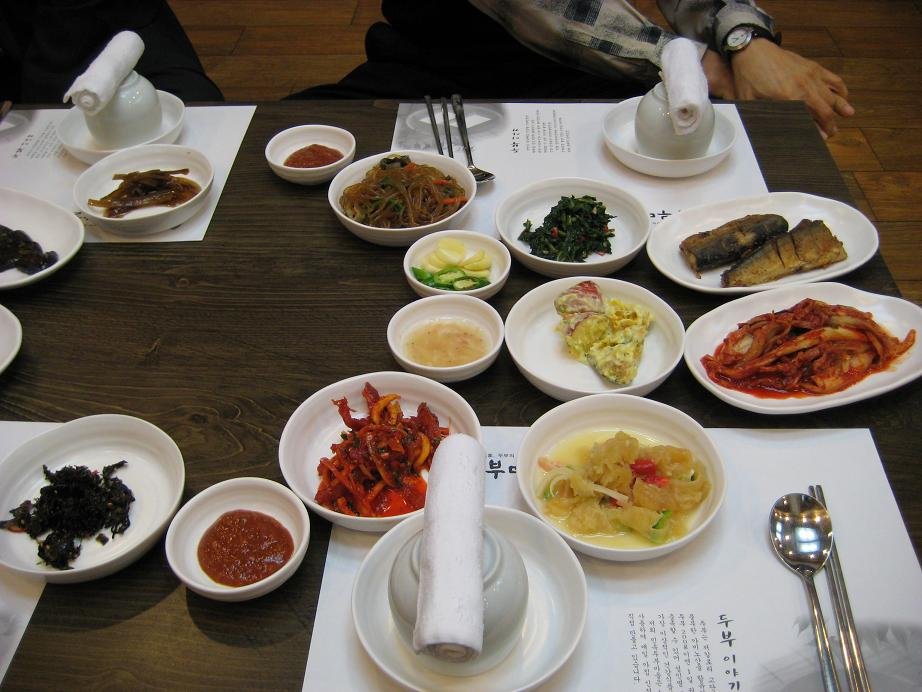
Banchan (반찬) are the small side dishes set around a bowl of rice and a bowl of soup at a Korean meal. The word itself breaks down simply: ban (飯) for rice, chan (饌) for dish, so the term literally just means “something to go with rice.” They’re not appetizers and they’re not really a course in the Western sense. They sit on the table the whole meal, shared by everyone eating, and get picked at in small bites between spoonfuls of rice.
The reason rice needs company explains a lot about Korean cooking. As Cho Young-ha, a researcher at the Academy of Korean Studies, put it to the Korea JoongAng Daily, plain rice “is not seasoned,” so it’s best eaten alongside foods that are, whether that’s meat, fish, or vegetables. Rice, soup, and banchan together are meant to produce, in her words, “the best flavor,” each dish doing a different job rather than competing with the others.
How many dishes, and why the number used to matter
Korean cuisine actually had a formal system for counting banchan, called cheop (첩), and for most of history it wasn’t arbitrary. A 3-cheop table was basic home fare. 5-cheop and 7-cheop tables were more elaborate, and 9-cheop was close to the top of what a commoner could serve. The ceiling was 12-cheop (십이첩), a table reserved for the king. Nobility and officials ate fewer dishes than that by design: the dish count was a visible marker of rank. One detail trips a lot of people up: kimchi was never counted in the cheop total. It was assumed, present at every meal regardless of status, the way bread might be at a European table.
That formal system has mostly faded from daily life, but its logic hasn’t disappeared. A home dinner or a basic restaurant meal in Korea today tends to land around four or five banchan, a figure the Korea JoongAng Daily cites as the rough national norm. Go further south into Jeolla Province, though, and that norm stops applying.
- Korean name
- 반찬 (banchan)
- Typical dish count
- 4-5 at a home or casual restaurant meal
- Historic court maximum
- 12 cheop (12 dishes), reserved for the king
- Does kimchi count as banchan?
- No — it's served automatically, outside the cheop count
- Region known for the most banchan
- Jeolla Province, especially Jeonju's makgeolli alleys
The classic dishes everyone recognizes
A few banchan show up often enough that they’re basically assumed on any table, whatever the main course is.
Kongnamul muchim is soybean sprouts, blanched and tossed with sesame oil, garlic, and a little salt, usually served cold or at room temperature. Sigeumchi namul does the same basic treatment to spinach. Both fall into the broader namul category: steamed or parboiled vegetables dressed simply enough that the vegetable itself still tastes like something.
Myeolchi bokkeum is dried baby anchovies stir-fried with soy sauce, a little sugar, and often garlic or chili, until they turn glossy and slightly sticky. It’s salty and a little sweet, meant to be eaten in small pinches, not by the spoonful. Gyeranmari is a rolled omelet, sometimes layered with vegetables or seaweed before it’s rolled, sliced into neat rounds. Oi muchim, a quick-pickled, often spicy cucumber salad, shows up constantly because it’s fast to make and cuts through richer dishes nearby on the table.
Japchae, the stir-fried glass noodle dish with vegetables and usually beef, occupies a slightly different space. It can anchor a meal on its own, but it’s also served as a banchan, particularly at holidays and larger gatherings. Then there’s kimchi itself, which exists in dozens of regional and seasonal varieties beyond the standard napa cabbage version, though as noted above, it technically sits outside the cheop count rather than inside it.
Beyond individual dishes, banchan generally fall into a handful of cooking methods: namul (blanched or steamed and seasoned), bokkeum (stir-fried), jorim (simmered in seasoned liquid), jjim (steamed), and jeon (pan-fried, often batter-dipped). Fermentation runs through a lot of this too, a habit that took hold partly because cooking oil was scarce in Korea for long stretches, pushing cooks toward soy-based seasonings, salt, and time instead of frying.
Banchan versus the main dish
A Korean table doesn’t really organize itself around a single “main” the way a Western plate does. Rice and soup anchor the meal, banchan surround them, and whatever protein or stew is on the table gets eaten alongside the side dishes rather than dominating the plate. Diners alternate: a bite of rice, a bite of banchan, maybe a spoonful of soup, repeating in whatever order suits them. A few table habits go with this style: the rice bowl or a side dish isn’t picked up to eat from directly, and spoons or chopsticks don’t get left standing upright in a rice bowl between bites.
There’s also a philosophical layer to how banchan sets are supposed to be built, at least traditionally: a framework built around five colors tied to the cardinal directions, with dishes served in odd-numbered sets of three, five, seven, or nine, because odd numbers carry good-luck associations in yin-yang thinking. How strictly any given household or restaurant follows that today varies enormously.
Where the real variety comes from
Jeolla Province, in Korea’s southwest, has the strongest reputation for serving unusually large and varied banchan spreads. In Jeonju specifically, the city’s makgeolli alleys are known for setting out 20 or more side dishes with a single order of the rice wine, among them things like buckwheat crepes, grilled mackerel, and mussel soup, for a price (around 65,000 won for four people) well above what a standard meal with four or five banchan would cost. It’s less a fixed menu than a running show of what the kitchen has that day.
Seasonality shows up too, if more quietly: squash dishes like hobak bokkeum are associated with summer, while burdock root preparations such as ueong jorim tend to appear in fall, tracking what’s actually in season rather than running the same rotation year-round.
Home kitchens, restaurant habits, and a 2026 argument
At home, banchan making is less about plating dozens of individual bowls and more about batch cooking and storage. Home cooks describe keeping larger containers of a few staples in the fridge and refilling them as needed over several days, reserving the neat individual small dishes mostly for guests, since fermented and pickled banchan keep well for stretches at a time. Korean dramas tend to show a much more composed, restaurant-style spread than what a typical weeknight table actually looks like.
Restaurants are where the long-running debate over banchan sits right now. Korea briefly tried to restrict free side dishes ahead of the 1986 Asian Games and 1988 Seoul Olympics, introducing an “Order Menu System” in 1983 meant to limit free extras to condiments like soy sauce, gochujang, and doenjang. It didn’t survive contact with customers or restaurant owners, and by 1987 the government had revised its own guidance to allow up to eight free side dishes instead. As of early 2026, that same tension is resurfacing: agricultural price inflation and labor costs are pushing some restaurant owners to debate openly whether unlimited banchan refills, especially with cheap meals like gukbap, still make financial sense. One proposed compromise circulating is to keep basic sides free while charging for pricier, more labor-intensive ones. Separately, hygiene concerns around recycling banchan between customers have pushed more restaurants and homes toward individual serving plates and self-service bars rather than shared communal dishes. None of this is settled yet, and there’s no single current rule: practices vary restaurant to restaurant.
More Korean food on this site: bibimbap, the mixed rice bowl banchan often ends up folded into, and how a Korean table actually works, for the bigger picture banchan fits into.