
Korean food
Korean Corn Dogs: What’s Inside, and How to Make One
감자핫도그 · gamja hotdog
Deep-fried and rolled in crunchy toppings, from panko to cubed fries: how Korea turned the American corn dog into gamja hotdog, why chains selling it have spread from Busan to New York and Toronto, and what's actually inside one.
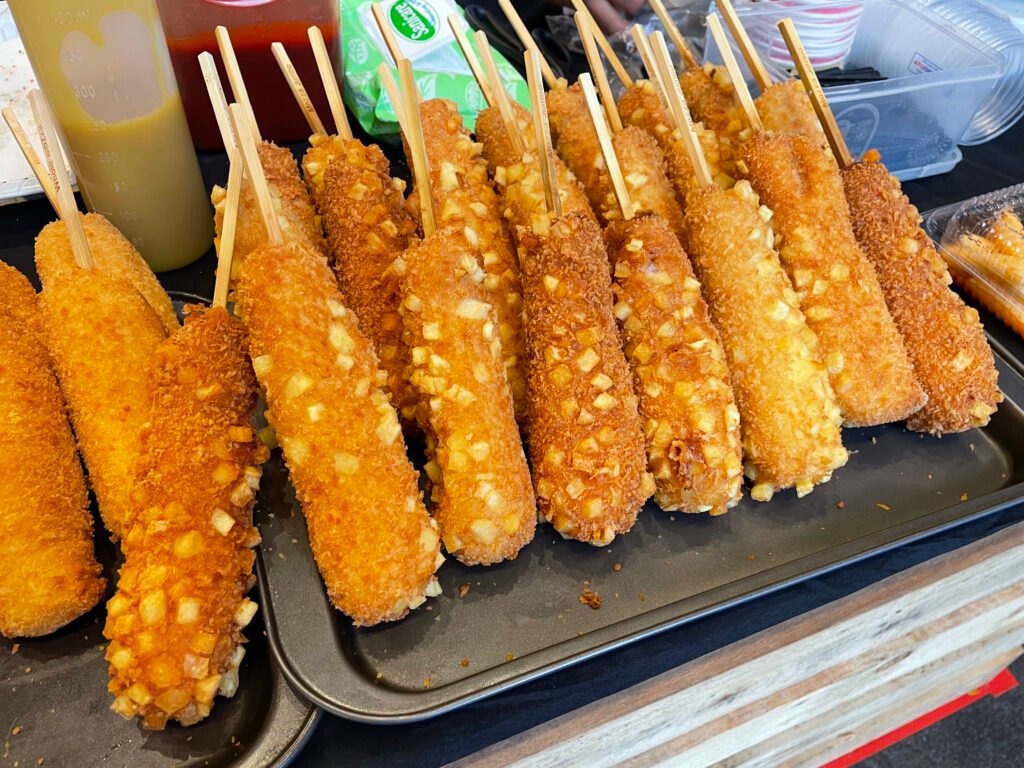
A Korean corn dog is a hot dog, a block of mozzarella, or both together on a wooden skewer, dipped in a yeasted dough, often rolled in diced potato cubes or crushed ramen noodles, then deep fried and finished with sugar, ketchup and mustard. In Korea it is simply called hotdog (핫도그), and the half-and-half version is one of the country’s most popular street snacks.
What is a Korean corn dog?
The Korea Tourism Organization’s cultural service, the Korean Cultural Center in Los Angeles (KOCIS), traces the snack to the 1980s, when corn dogs became an established street food in Korea. The classic version it describes is “thickly battered and chewy dough with a sausage inside,” sprinkled with sugar and drizzled with ketchup and mustard. A famous 1990s variant coated the dough in thickly chopped french fries, and picked up a string of nicknames: mandeukee, motnanee (“ugly one”), gamja (potato), dokkebi (goblin), or yetnal (old-fashioned).
Maangchi, who has a recipe for the potato version, lists its Korean name as gamja-hotdog and its nicknames as mandeugi hotdog, “ugly hotdog” (못난이 핫도그) and “goblin’s club hotdog” (도깨비방망이 핫도그). She notes mandeugi comes from a 1990s Korean comedy sketch, while the other names poke fun at the dog’s lumpy, spike-covered look once it is coated in potato and fried.
Chowhound reports that the corn dog concept reached Korea after American soldiers introduced it following World War II, and that it caught on as a street food through the 1980s. KOCIS adds that contemporary shops have pushed the format into mozzarella, cheddar, kimchi, tteok, ramen crust, squid ink, bacon and shrimp versions, topped with everything from wasabi to fruit-flavored sugars.
The naming itself causes confusion. As cited in a Barry Popik etymology post on the term, a corn dog in Korean is usually just called “hot dog” (핫도그), which collides with the word for an actual hot dog on a bun. Shops and customers also use “kogo” for the french-fry-crusted version, on top of the gamja-hotdog and goblin’s-club nicknames already mentioned. English-language coverage mostly settled on “Korean corn dog” to keep it distinct from a plain hot dog.
- Korean name
- 감자핫도그 (gamja hotdog)
- Also called
- Korean hot dog, corn dog on a stick
- What it is
- A hot dog or rice cake on a stick, battered and deep-fried
- Common toppings
- Panko breadcrumbs, cubed french fries, ramen crumbs, sugar
- Where it spread
- US, Canada and UK, via dedicated chains since the early 2020s
- Signature chain
- Myungrang Hotdog
How a Korean corn dog differs from an American corn dog
The two snacks share a shape and a stick, and not much else. Tasting Table breaks down the batter difference plainly: the American corn dog uses a cornmeal batter that behaves like sweet cornbread, built from cornmeal, flour, sugar and a leavener. The Korean version swaps that out for a yeasted batter made with wheat and rice flour, which fries up lighter and chewier instead of cakey.
Chowhound’s reporting lines up with that: Korean corn dogs are built on sausage, mozzarella, fish cake, or a sausage-and-cheese combination, and the yeasted dough is coated in panko breadcrumbs for extra crunch before frying, rather than relying on the batter alone for texture.
The toppings are where the two snacks really part ways. An American corn dog gets mustard or ketchup served on the side. A Korean one is sugared, sauced and crumb-coated before it ever reaches the customer: diced potato, crushed ramen, crushed cornflakes, or panko pressed into the wet batter, then a dusting of sugar and squeeze bottles of ketchup, mustard, sweet chili sauce or mayo over the top. Nothing is optional and nothing is served separately.
There’s also a filling difference that changes how the thing eats. An American corn dog is built around one hot dog, full stop. A Korean one is commonly sold three ways: all sausage, all mozzarella, or a half-and-half stick with sausage on one end and cheese on the other, so the cheese stretches out in a long pull with the first bite. That half-and-half version, dusted in sugar with ketchup and mustard striped across it, is usually what people mean when they just say “Korean corn dog” online.
Recipe: Maangchi’s gamja-hotdog (potato corn dog)
Maangchi’s version, which serves four, uses a simple yeasted dough and skewers the hot dogs on wooden chopsticks before coating them in parboiled potato cubes and breadcrumbs.
Ingredients
For the dough:
- 1 cup lukewarm water
- 2 tablespoons sugar
- 1 package dry yeast (about 2 teaspoons)
- ½ teaspoon kosher salt
- 1¾ cups all-purpose flour
For assembly and frying:
- 4 uncured beef hot dogs
- 4 wooden chopsticks
- 1 pound peeled potato, cut into ¼-inch cubes, rinsed and soaked
- 2 tablespoons all-purpose flour
- ½ cup bread crumbs (panko or Korean ppang-garu)
- Oil for frying, about 4 inches deep
- Sugar, ketchup and yellow mustard, for serving
Method
Stir the warm water and sugar together, add the yeast, and wait until it dissolves. Mix in the salt and flour with a wooden spoon for about two minutes, until smooth, then cover the bowl and let it rise for an hour, until doubled.
While the dough rises, boil a quart of water and blanch the drained potato cubes for two minutes. Drain them, rinse under cold water to wash off the surface starch, and dry thoroughly with a towel. Toss the dry potato with the two tablespoons of flour, then skewer each hot dog on a wooden chopstick.
Heat the oil to 320-330°F; it’s ready when a chopstick dipped into the dough bubbles vigorously. Coat each hot dog in the risen dough, roll it in the potato cubes, pack the potato on with your hands, and finish with a roll in the breadcrumbs. Fry for six to seven minutes until golden, turning as needed, and lift out with tongs. Dust the hot dogs with sugar while they’re still warm, and finish with ketchup and mustard.
Myungrang Hotdog and the global corn dog boom
Korean corn dogs stayed a domestic street snack for decades before the current wave of specialty chains turned them into an export. KOCIS dates the resurgence to 2016, when franchise brands built entirely around the corn dog format began to open, including Chung Chun Rice Dog and Myungrang Hot Dog. KOCIS also notes that the format’s low equipment and skill requirements made it an attractive small-business option during a tough stretch for Korea’s economy.
Myungrang in particular started small: the chain traces back to a single market stall near Pusan National University in 2016, by the company’s own account reported by blogTO at the opening of its first Canadian location in Toronto in March 2022. From there it grew into, in the company’s words, “the number one hot dog brand and a household name in Korea,” with more than 650 locations worldwide as of that report.
The international rollout followed quickly. Myungrang opened a UK location in Islington, London, in March 2022, the same month as its Toronto debut, according to coverage in The Caterer. US locations multiplied through the following years: Axios reported in July 2025 that the chain had reached 15 US locations, including a Columbus, Ohio shop selling the original hot dog for $5 and a squid-ink version for $7.
NBC News reported that Korean corn dogs moved from a niche item found mostly in H Mart food courts to a mainstream US trend after a wave of social media attention in 2021, and that the momentum was still building as of 2024, with chains such as Two Hands, Oh K-Dog NYC, Ssong’s Hotdog and K-Street Hotdog opening outlets well outside the usual hubs for Korean food, including Arkansas, Kansas, Texas and Missouri. NBC News also noted that distributors started importing Korean corn dogs into the US around the same period the franchises began opening, roughly three years before that report.
That spread has made the half-and-half sausage-and-cheese dog, finished in sugar and crushed ramen, one of the more recognizable Korean street foods outside Korea, alongside tteokbokki and mandu.
More Korean food on this site: Korean fried chicken, the double-fried street classic, hotteok, the sugar-filled winter pancake, and kimbap, the rice rolls often sold from the same street carts.