Korean food
Naengmyeon: What Korea’s Cold Noodle Dish Actually Is
냉면 · naengmyeon
Naengmyeon, Korea's cold buckwheat noodle dish, splits into two camps: a mild broth-based version from Pyongyang and a spicy, brothless one shaped by Hamhung refugees. Both outlasted a war, a summit, and a century of arguing over whether they belong in summer or winter.
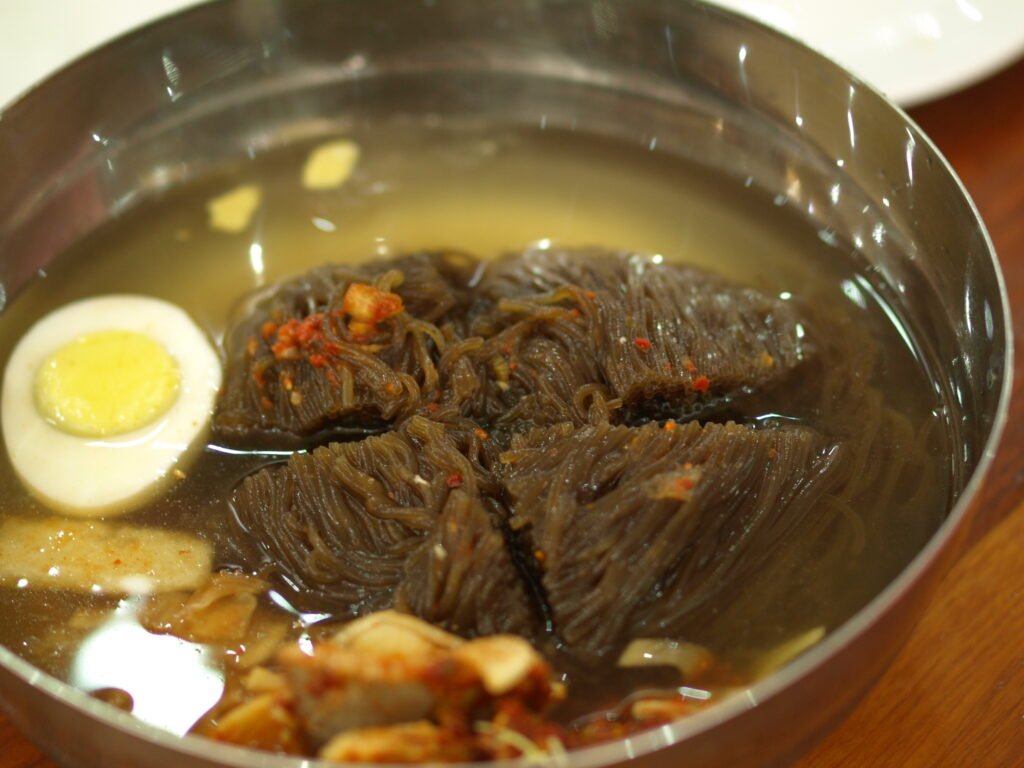
Naengmyeon (냉면) means, plainly, cold noodles. It’s a family of dishes built around long, thin noodles made mostly from buckwheat flour, often cut with sweet potato or potato starch. There are two main versions: mul naengmyeon, served in a bowl of icy, tangy broth, and bibim naengmyeon, which skips the broth for a spicy, vinegary sauce instead. Both trace back to the north of the peninsula, in what is now North Korea, and both outlasted a war and a century of arguing over whether they’re a summer dish or a winter one.
Mul versus bibim: the two main styles
Mul naengmyeon arrives in a bowl of chilled broth, usually a beef stock, a tangy dongchimi (radish water kimchi) base, or a mix of both. Bibim naengmyeon leaves the broth out entirely. The noodles get tossed in a spicy, vinegar-forward gochujang sauce and served dry, often with a small cup of broth on the side for sipping between bites.
Neither version uses wheat noodles, which is part of why the chewiness catches people off guard the first time. A noodle that’s mostly buckwheat comes out soft and a little crumbly, while one made heavier on sweet potato starch turns glassy and springy, to the point that it’s genuinely hard to bite through without help. That’s also why the noodles are traditionally served uncut: cutting them was once thought to symbolize cutting short one’s life or luck. Most restaurants hand out kitchen scissors anyway, and snipping the noodles at the table before eating is completely normal now, superstition aside.
- Korean name
- 냉면 (naengmyeon)
- Main noodle flour
- Buckwheat, often blended with sweet potato or potato starch
- Two core styles
- Mul naengmyeon (cold broth) and bibim naengmyeon (spicy, no broth)
- Regional origin
- Pyongyang (mul style) and Hamhung (spicier hoe-naengmyeon style)
- First documented mention
- 1643
- Traditionally a winter or summer dish?
- Winter, originally - tied to the autumn buckwheat harvest
A northern dish, split by two cities
The earliest surviving written mention of naengmyeon dates to 1643, though people were almost certainly eating some version of cold noodles before that got written down. For most of its early history it wasn’t a summer food at all. It was tied to Pyongyang and the northern provinces, eaten through the cold months while the autumn buckwheat harvest was still fresh.
Mul naengmyeon is the Pyongyang version: buckwheat-forward noodles in a mild, often beef-based broth. Hamhung, a port city further north and east, produced something different. Hamhung-style naengmyeon (sometimes called hoe-naengmyeon) uses noodles made almost entirely from potato or sweet potato starch, giving them a markedly chewier bite, dressed in a spicier, more vinegar-forward sauce, and sometimes topped with thin slices of marinated raw fish. This is the direct ancestor of what most people now call bibim naengmyeon.
The dish spread south after the Korean War, carried by refugees who had fled Pyongyang and Hamhung and settled in Busan and other southern cities. Restaurants opened serving the northern recipes from memory, and naengmyeon gradually became a national dish rather than a regional one, alongside the rest of Korean food culture.
What’s actually in the bowl
A bowl of mul naengmyeon typically carries half a boiled egg, thin cucumber matchsticks, slices of Korean pear, pickled radish, and sometimes slices of cold beef brisket, all floating in that chilled broth. Bibim naengmyeon carries most of the same toppings minus the broth, with the noodles and sauce doing the work instead.
Either way, the diner finishes the seasoning themselves. Small containers of vinegar and hot mustard sit on the table, and it’s normal to add both to taste rather than trust whatever balance the kitchen sent out.
Why a “summer” dish started out as a winter one
The seasonal story most people know is close to backwards. Naengmyeon reads today as a hot-weather order, the thing you get when it’s too warm to want soup. But buckwheat is harvested in the north from mid-October into early November, and it was originally eaten fresh right after that harvest, while the flavor was strongest. There’s also a more domestic explanation in circulation: ondol, Korea’s traditional underfloor heating, often ran hot enough in winter that a cold dish indoors was a relief rather than an odd choice.
It wasn’t until ice-making plants opened in Busan in the early twentieth century that naengmyeon could be served reliably cold year-round, and restaurants began marketing it as a summer specialty instead. The older habit never fully disappeared. It’s still common to order naengmyeon as the closing course after a hot, fatty Korean barbecue meal, using the cold broth or sharp vinegar bite to cut the grease, which lines up with the dish’s original winter logic even if nobody frames it that way now.
The noodles that showed up at a summit
Naengmyeon got an unusual moment of international attention in April 2018, during the inter-Korean summit between South Korean President Moon Jae-in and North Korean leader Kim Jong Un. At Moon’s request, Kim arranged for Pyongyang-style naengmyeon to be flown in from the North, along with a chef from Pyongyang’s Okryu-gwan restaurant to prepare it for the summit banquet. Kim opened his remarks with a joke about the dish, saying something close to “I hope President Moon enjoys this Pyongyang naengmyeon from afar, though I suppose I shouldn’t say ‘afar'”, a nod to the two leaders finally meeting face to face, and the room reportedly laughed. The noodles became a minor sensation in South Korea afterward, with lines forming at naengmyeon restaurants as people tried to recreate a piece of the summit menu at home.
Picking a lane: mul, bibim, or hoe
For a first try, mul naengmyeon is the gentler entry point: cold, mildly tangy broth, soft buckwheat noodles, not much heat. Bibim naengmyeon is built for people who want chili and vinegar up front, with noodles that fight back a little more on the bite. Hoe-naengmyeon sits a notch further out, adding raw marinated fish to that same spicy base, and shows up less often outside dedicated Korean restaurants or Hamhung-style specialists. None of the three is a lesser version of the others. They came out of two cities with two different climates and two different relationships to buckwheat, and the argument over which one is the “real” naengmyeon has been running since long before the noodles crossed the DMZ.
More Korean food on this site: banchan, the side dishes that usually share the table with a main noodle order, and bibimbap, for another take on how Korean kitchens build a bowl around rice instead of noodles.