
Korean food
Bossam: Korea’s Boiled Pork Belly Wraps, and How It Differs From Jokbal
보쌈 · bossam
Bossam is Korea's boiled, thinly sliced pork belly, wrapped in lettuce or napa cabbage with ssamjang and spicy radish salad. Born from the winter kimjang kimchi season and a favorite drinking food, it's often paired with raw oysters as gul-bossam, and easily confused with its braised cousin, jokbal.
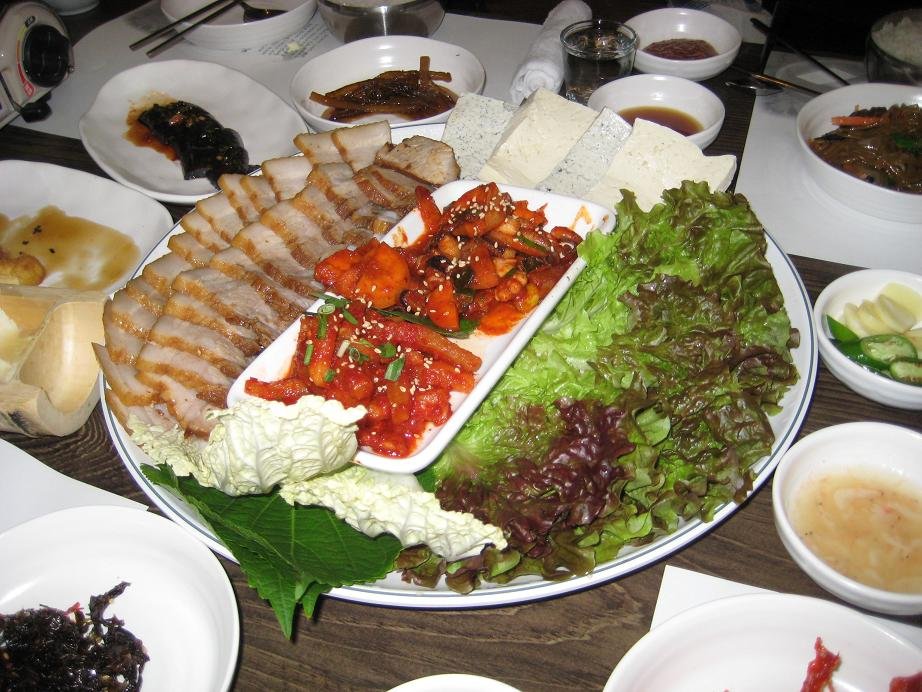
Bossam (보쌈) is a Korean pork dish built around one idea: boil the meat until tender, slice it thin, and let everyone at the table wrap it themselves. The pork, usually belly, sometimes shoulder, is simmered rather than grilled or fried, in a broth loaded with garlic, ginger, scallion, onion, bay leaf, and often doenjang. Some cooks add a spoonful of instant coffee, and older recipes call for tea leaves, all aimed at the same goal: cutting the gamey smell pork belly can carry. Once it’s cooked, the meat is tied with kitchen twine, pressed in cloth while still warm, cooled, and sliced about 0.3 centimeters thick.
What actually lands on the table
The sliced pork comes out next to a spread of greens: lettuce, perilla leaves, or whole napa cabbage leaves, plus ssamjang (a thick dip of doenjang, gochujang, garlic, and sesame oil), raw garlic cloves, salted shrimp, and a spicy radish salad usually called musaengchae or bossam-kimchi. Many tables add raw oysters on the side. None of this arrives plated as a finished dish. It’s set out for assembly, piece by piece, at the table.
- Korean name
- 보쌈 (bossam)
- Literal meaning
- "Wrapped" or "packaged," from a hanja root for a wrapping cloth
- Main protein
- Pork belly (sometimes shoulder or neck)
- Cooking method
- Boiled, not braised or grilled, with garlic, ginger and aromatics
- Core wrap ingredients
- Lettuce or napa cabbage, ssamjang, raw garlic, spicy radish salad
- Often confused with
- Jokbal (braised pig's trotters) - different cut, different cooking method
Bossam and jokbal aren’t the same dish
People new to Korean pork dishes often lump bossam together with jokbal, and the mix-up makes sense: both come sliced with lettuce, ssamjang, and garlic, both work as shareable late-night food, and delivery apps in Korea frequently sell them as a paired combo. But they’re different cuts cooked different ways. Jokbal is made from pig’s trotters, braised, not boiled, in soy sauce, ginger, garlic, rice wine, and aromatics like cinnamon or black pepper, which gives it a sticky, gelatin-rich texture and a darker, sweeter-savory flavor. Bossam uses pork belly or a similar cut boiled in a lighter, soy-free broth, which produces a plainer slice of meat that leans on the radish salad and ssamjang for its punch.
Jokbal’s modern identity is tied to one Seoul neighborhood, Jangchung-dong, popularized in the 1960s by cooks who had migrated from Hwanghae and Pyongan provinces, and picked up a following among wrestling fans at the nearby Jangchung Gymnasium. Bossam has no equivalent single-neighborhood origin story. It stayed closer to its rural, seasonal roots.
What the word means, and the wrapping tradition it belongs to
Bossam literally means “wrapped” or “packaged.” The name traces to a hanja root for a wrapping or swaddling cloth, which fits both how the dish is made, meat tied and pressed in cloth, and how it’s eaten, one leaf-wrapped bite at a time.
That naming sits inside a much larger category of Korean food called ssam (쌈), which simply means “wrapped.” Ssam isn’t one dish but a method: rice, meat, or seafood folded into a leaf and eaten whole. The practice is traced back to the Goryeo period, when Buddhist restrictions on meat pushed cooks toward vegetable-forward preparations, and a Yuan-dynasty poet recorded Goryeo people eating rice wrapped in raw vegetables. By the Joseon era, ssam was established enough that scholars wrote about its etiquette, advising smaller, tidier bites so a diner could keep their composure at the table. Dozens of ssam variants exist beyond bossam: sangchu ssam with lettuce, baechu ssam with napa cabbage, gimssam with seaweed, kkaenip ssam with perilla leaves, even versions built around raw fish. Bossam is one specific, pork-centered branch of that wider wrapping tradition, not a one-off invention.
What its history actually supports
Several sources tie bossam directly to gimjang, the seasonal ritual of making large batches of kimchi before winter, a tradition UNESCO recognized as Intangible Cultural Heritage in December 2013. During the Joseon period, landowning yangban families are described as providing a pig to the laborers who helped with the kimchi-making, and the freshly boiled pork was eaten together with that season’s still-crisp kimchi. That pairing, hot tender meat against sharp, half-fermented cabbage, is often cited as bossam’s starting point, and it holds up across sources. Beyond that, claims of a specific royal-court invention, or of named regional schools of bossam the way jokbal has its Jangchung-dong lineage, don’t turn up in verifiable form, so they’re left out rather than guessed at.
Why oysters show up in winter
Gul-bossam, bossam served with raw oysters, is one of the dish’s best-known variations, and the timing isn’t incidental. Korean winter is considered oyster season: the cold water is credited with making the shellfish firmer, and oysters harvested in these months are prized for being low in calories but high in protein, glycogen, minerals, and vitamins. Since bossam itself is tied to the cold-weather gimjang season, the two foods were simply in season at the same table. The richness of boiled pork belly against the clean, briny snap of a raw oyster is the kind of contrast Korean home cooking leans on constantly: fatty meat cut by something acidic, crisp, or mineral.
How it’s actually eaten
The technique is fairly consistent. A lettuce or cabbage leaf goes flat in the palm. A slice of pork belly sits in the center. From there, diners add what they like: a dab of ssamjang, a piece of salted shrimp, a sliver of raw garlic, a small pile of the spicy radish salad, maybe a bit of kimchi or an oyster. The leaf folds around all of it and gets eaten in one bite, not nibbled in two, which is part of why the older etiquette writing stressed small, manageable portions. The dish rewards restraint in portioning and generosity in combining flavors within that one wrap.
Bossam today
Bossam’s standing as anju, food meant to go with drinking, hasn’t faded. It’s still one of the dishes ordered to share over soju or beer, and alongside jokbal, it’s one of the most common orders on late-night food delivery in Korea, precisely because one order is built to split across a group rather than eat alone. That makes it as much a social dish now as it was during the communal gimjang gatherings it grew out of.
More Korean food on this site: Korean BBQ, for the grilled side of pork belly, and banchan, for the side dishes that round out a bossam table.