
Korean food
Doenjang Jjigae: Korea’s Everyday Soybean Paste Stew
된장찌개 · doenjang jjigae
Korea's everyday soybean paste stew, simmered with vegetables and tofu in a bubbling earthenware pot — a home-cooking staple older and milder than its spicier, more famous cousins.
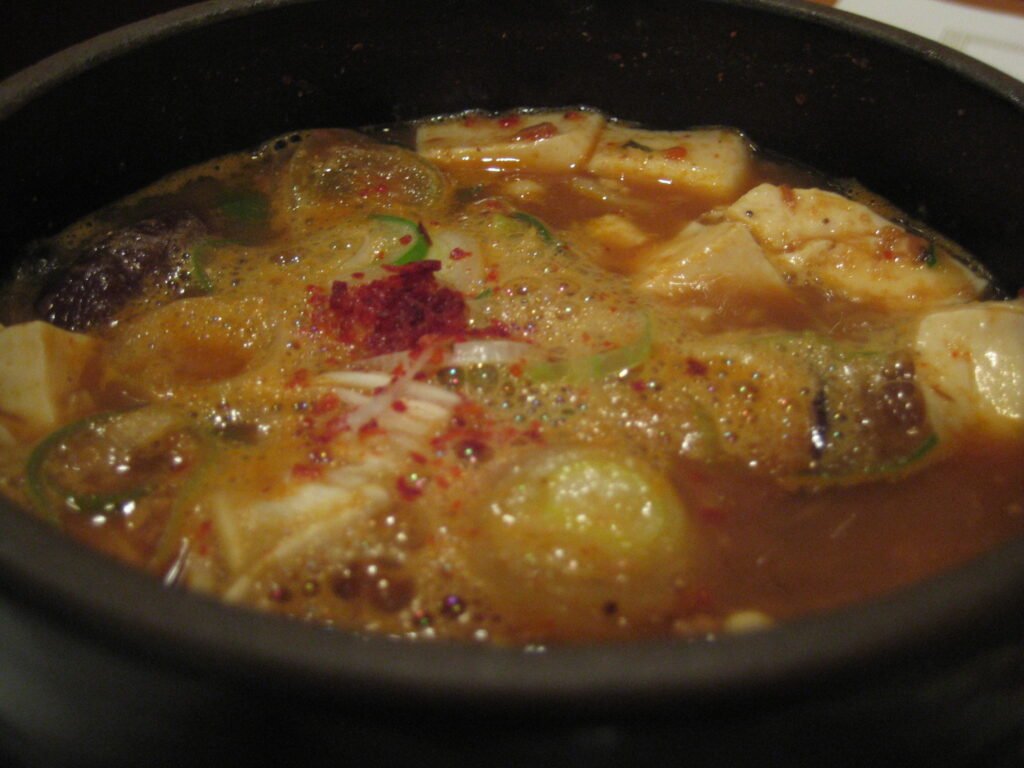
Doenjang jjigae is Korea’s everyday soybean paste stew, built from doenjang simmered with vegetables, tofu, and often a little seafood or meat, and served bubbling hot as the centerpiece of a home-cooked meal rather than as a restaurant specialty. It is one of the most common dishes made in Korean kitchens, standing alongside rice and kimchi as a baseline of daily eating.
What goes into the pot
A basic doenjang jjigae starts with doenjang dissolved into a stock, most often one made from dried anchovies and dashima (kelp), though some cooks simply use rice-rinsing water or plain water. Into that base go zucchini, potato, onion, mushrooms, and green chili pepper, along with medium-firm tofu cut into cubes. From there the dish branches: some versions add small clams, mussels, shrimp, squid, or oysters for a briny edge, while others use beef or pork for a meatier stew. Garlic and sliced green onion usually go in near the end. Traditionally the stew is cooked and served in a ttukbaegi, a thick earthenware pot that holds heat long after it leaves the stove, so the jjigae keeps bubbling at the table. Earthenware takes noticeably longer to come to a boil than stainless steel, close to fifteen minutes compared to seven or eight, which is part of why the stew is associated with a slow, rolling simmer rather than a quick boil.
- Korean name
- 된장찌개 (doenjang jjigae)
- Literal meaning
- "Soybean-paste stew"
- Main ingredients
- Doenjang, zucchini, potato, onion, tofu, anchovy/kelp stock (optional clams, shrimp, beef, or pork)
- Base paste
- Doenjang (fermented soybean paste, from meju aged in brine)
- Serving style
- Served bubbling in a ttukbaegi as part of a full bapsang meal with rice and banchan
- Related dish
- Cheonggukjang jjigae (same soybean base, fermented only 2-3 days, much more pungent)
How doenjang itself gets made
Doenjang jjigae only tastes like doenjang jjigae because of what happens to soybeans long before they reach the pot. Soybeans are soaked overnight, boiled in salted water, then pounded or coarsely ground and shaped into bricks called meju. The bricks are dried for weeks, then hung from the eaves of a house or kept in a warm room to begin fermenting. Around the lunar new year they are sun-dried again and moved into large ceramic crocks called jangdok, submerged in brine, sometimes with charcoal and dried chilies added for preservation. After months of aging, the softened meju is separated: the solid matter is mashed into doenjang, while the liquid that drains off becomes ganjang, Korean soy sauce. Before refrigeration and commercial food production, making a year’s supply of doenjang and ganjang this way was a near-universal task for Korean households, done once a year and stored for the seasons ahead. Today the Korean government distinguishes three categories: hansik-doenjang, made the traditional way from meju and brine; doenjang made from a non-traditional meju and saline solution; and seasoned doenjang, blended from at least 90 percent pure doenjang base, a reflection of how much of today’s doenjang is produced industrially rather than fermented block by block at home.
A stew with old roots
Doenjang as an ingredient goes back further than the stew built around it. Murals in the fourth-century Goguryeo tomb Anak Tomb No. 3 depict vessels used for fermented soybean production, and a third-century Chinese text remarks that people of Goguryeo were skilled at brewing fermented soybeans. By 683 CE doenjang and other varieties of jang were formal enough to be served at the wedding of King Sinmun of Silla, and medieval records describe jang pastes being relied on as relief food during famines and invasions. The stew form familiar today is a later development: food historians trace an early version of doenjang jjigae to a dish called “curled mallow soup,” documented during the reign of King Yeongjo in the mid-1700s, and sources describe doenjang jjigae gaining popularity around this period specifically as a health food, built around vegetables, doenjang broth, and tofu for easy protein. Unlike gochujang, which carries its own distinct identity as Korea’s red chili paste, doenjang has mostly stayed in the background: a pantry staple rather than a dish people go out looking for, which is part of why doenjang jjigae reads as home cooking first and restaurant food second, in contrast to dishes like budae jjigae or kimchi jjigae that carry more specific origin stories tied to particular places or moments in Korean history.
Every household’s own version
Ask different Korean home cooks for their doenjang jjigae and the answers will not match. One food writer who grew up eating her mother’s version notes that her mother never added gochugaru (red chili flakes) to the stew, while she herself adds it for extra heat in her own kitchen, a small but telling example of how the same base dish shifts from one household to the next. Recipe writers describe pork-based and seafood-based versions as separate but equally legitimate variations rather than one being the “correct” doenjang jjigae. This kind of variation runs deeper than the stewpot: researchers studying traditional, home-fermented doenjang across different Korean provinces have documented measurable, region-specific differences in the paste itself, down to its chemical and flavor characteristics, which only reinforces how locally doenjang production and the dishes made from it have always varied.
Part of a full meal, not a dish on its own
Doenjang jjigae is rarely plated and eaten by itself. It belongs to the bapsang, the full table setting of steamed rice, soup or stew, and a spread of banchan (side dishes) that defines an ordinary Korean meal. The stew is often brought to the table still in its ttukbaegi and shared from the pot, spooned over rice rather than drunk on its own. Its place in Korean food culture runs deep enough that it is frequently the first solid, flavored dish introduced to a baby, served with soft rice once a child moves past plain infant food. For a broader look at how dishes like this fit together on a Korean table, see this site’s overview of Korean food culture.
A health food, and a mild one
Doenjang jjigae carries a reputation in Korea as a health food, a status tied directly to fermentation and soy. Doenjang contains isoflavones, which are associated with supporting cardiovascular health and bone density, along with lecithin and dietary fiber. That reputation also rests on contrast: next to spicier, chili-forward stews built on gochujang or gochugaru, doenjang jjigae is comparatively mild and savory, closer to a daily staple than an indulgence, which is part of why it is the stew many Koreans say they could eat every day without tiring of it.
Not to be confused with cheonggukjang
Doenjang jjigae is sometimes mixed up with a related but distinct dish, cheonggukjang jjigae, and the two pastes behind them are easy to confuse without knowing how differently they are made. Cheonggukjang is also a fermented soybean product, but it ferments for only two to three days using Bacillus subtilis at around 40°C, compared to the months-long aging doenjang undergoes in brine. That shortcut gives cheonggukjang a much stronger, more pungent odor, strong enough that an odorless version was developed in 1998 for people who find the smell off-putting, and it typically still contains some whole, uncrushed soybeans rather than being fully broken down into paste. Doenjang, by contrast, is milder and smoother, and recipes sometimes substitute doenjang for cheonggukjang specifically for diners who find the stronger stew too much. They are related by process, both built on fermented soybeans, but they are not interchangeable names for the same stew.
More Korean food on this site: read the Korean food culture overview for how stews like this one fit into a full meal, and see the gochujang guide for doenjang’s spicier fermented cousin.