
Korean food
Budae Jjigae: Korea’s Army Base Stew, from Scarcity to Comfort Food
부대찌개 · budae jjigae
Korea's "army base stew" turned a postwar shortage of food into one of the country's most recognizable comfort dishes — Spam, hot dogs, and baked beans simmered with kimchi and gochujang in one shared pot.
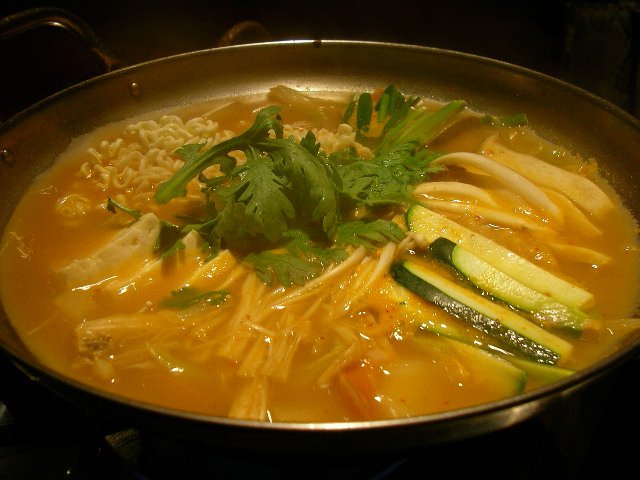
Budae jjigae is a Korean stew that mixes kimchi, gochujang, and tofu with American processed foods like Spam, hot dogs, and baked beans. It began in the 1950s near U.S. military bases, where Koreans stretched scarce food by cooking surplus and black-market army rations into a spicy, communal pot.
Where it comes from
The Korean War left the country in severe poverty. Estimates cited by historians put wartime and postwar deaths at roughly a tenth of the population, and food was scarce for years afterward. Around American military bases in Gyeonggi Province, cooks found a workaround: scraps and surplus from U.S. army kitchens, including canned meat, sausages, and cheese, could be stretched into something that fed a family. An early version of this improvisation was called kkulkkuri-juk, or “pig slop porridge,” sometimes also referred to as “UN Stew.” It was crude food born of necessity, not a planned dish.
Several towns near U.S. installations claim a piece of the origin story, among them Uijeongbu, Dongducheon, Pyeongtaek, and Songtan. Uijeongbu has leaned into the association the hardest. The city has maintained a street dedicated to the dish since 1998, and it holds an annual Uijeongbu Budae Jjigae Festival that drew more than 15,000 visitors to its 17th edition in 2024.
Spam itself did not become legal to sell in South Korea until 1987, after democratization loosened import rules. Before that, bringing it off base was smuggling, and Korean sources describe the penalties for food smuggling in the early postwar years as severe, even by the standards of the time. The canned meat that shows up in budae jjigae today, in other words, started out as contraband.
- Korean name
- 부대찌개 (budae jjigae)
- Literal meaning
- "Army unit stew" / "army base stew"
- Key ingredients
- Spam, hot dogs or sausages, baked beans, kimchi, gochujang, tofu, instant ramyeon, American cheese
- Origin
- Postwar 1950s Korea, near U.S. military bases in Uijeongbu, Dongducheon, Pyeongtaek and Songtan
- Status today
- Mainstream comfort food; Michelin-listed (2019), served nationwide and in diaspora restaurants
- Related dish
- Kimchi jjigae, Korean hot pot (jeongol)
The restaurant credited with starting it
Most accounts trace the dish’s commercial start to a single restaurant in Uijeongbu called Odeng Sikdang, opened by a North Korean defector named Heo Gi-suk. Sources disagree on exactly when. Some accounts, including a 2024 Korea Times profile of the restaurant, put the founding at 1960, describing Heo as a street vendor who first sold odeng (fish cake) before a customer who worked near the U.S. Army camp asked her to cook some leftover meat he had access to. He reportedly wanted it served with rice and soup rather than just fried, and the combination customers kept asking for became the stew. Other sources, including the GyeongGi Cultural Foundation’s own history of the dish, date the restaurant’s founding to 1968. Neither date is confirmed beyond these competing accounts, and it isn’t clear which is correct.
What both sides agree on is that Odeng Sikdang moved from a street stall to a permanent building, and that it kept operating for decades. Heo Gi-suk died in 2014, but the restaurant has continued under the same name, and roughly two dozen budae jjigae restaurants now line the same stretch of Uijeongbu, each keeping its own version of the broth.
What the name actually means
Budae means “military unit” or “troops,” and jjigae is the general Korean word for a thick, stew-like dish cooked and often served in a shared pot. Put together, budae jjigae translates literally to “army unit stew,” which English-language write-ups usually shorten to “army stew” or “army base stew.” The name was never an official coinage. It spread by word of mouth among people who ate near the bases, and it stuck because it described exactly what was going into the pot.
In Yongsan, home to a major U.S. garrison in Seoul, a related dish known as Johnson-tang developed with its own mythology: the name is said to date to President Lyndon B. Johnson’s 1966 visit to South Korea, and the dish swaps out kimchi for plain napa cabbage and usually skips ramyeon noodles. This appears to be a Yongsan-specific tradition rather than evidence for budae jjigae’s national history, and it should be read that way rather than as the dish’s origin story.
In 1999, Uijeongbu’s city government tried rebranding the dish locally as “Uijeongbu jjigae,” hoping to shed the military association. The new name never caught on, and budae jjigae remained the name everyone used.
How the dish is built
A pot of budae jjigae usually starts with a gochugaru-spiked broth, kimchi, tofu, and often a hefty spoonful of gochujang. Into that goes some combination of Spam, hot dogs or sausages (Vienna sausages are common), baked beans, and sometimes ham or bacon. Many restaurants cook it tableside in a shallow pan over a portable burner, letting diners watch it come together and add ingredients as it goes.
Modern versions lean into additions that weren’t part of the original improvisation: a block of instant ramyeon noodles dropped in near the end of cooking, a slice or two of American cheese melted over the top, rice cakes (tteok) for extra chew, and occasionally macaroni. Regional styles differ too. Songtan versions tend to be richer, built around cheese and canned beans with a thicker broth. Uijeongbu and Dongducheon versions are typically lighter, leaning on barley-based gochujang and a heavier hand with ham and sausage. Spam in particular has taken on a role beyond just an ingredient. Because it was a scarce, prestigious import for decades, having “real” Spam in the pot (as opposed to a cheaper off-brand canned meat) is still treated by some diners as a marker of a better bowl.
From shame to comfort food
For a long time, budae jjigae carried the stigma of where it came from. It was food that signaled poverty and a dependence on an occupying military’s leftovers, and the name itself was treated as something embarrassing in parts of Korean food writing for years. Early versions of the predecessor dish were reportedly rough enough that diners sometimes found bits of trash mixed into the scraps that went into the pot.
That reputation shifted as South Korea’s economy grew and the dish’s wartime associations faded from living memory. By the time food writer Anthony Bourdain ate it on television in 2015, he described it as proof that necessity could be the mother of deliciousness, a line that got repeated widely in Korean press. A 2016 survey of Korean tourists found it ranked among their most-missed dishes while traveling. The Michelin Guide listed it among South Korea’s must-eat dishes in 2019. Today it is firmly mainstream: the Nolboo chain alone operates close to 1,000 budae jjigae restaurants, and the dish shows up on menus from Seoul to diaspora restaurants abroad, served now as nostalgia rather than necessity.
The dish still carries some tension in how it’s talked about. Some writers frame it as a quiet symbol of how far the country has come, a scrappy survival food turned into something people choose to eat. Others are more wary of the history behind it, pointing out that it’s also a direct record of postwar dependency and hardship that shouldn’t be flattened into a feel-good story. Both readings show up in Korean food writing, and neither has fully displaced the other.
More Korean food on this site: budae jjigae belongs to the same family of communal, broth-based Korean stews as kimchi jjigae, though its mix of Korean staples and American army-base ingredients makes it a very different pot. For a wider look at how it fits alongside other shared-pot dishes like jeongol, see our guide to Korean hot pot.