Korean food
Jjamppong: Korea’s Spicy Seafood Noodle Soup, and Its Japanese Roots
짬뽕 · jjamppong
Jjamppong is a spicy, chili-red Korean-Chinese seafood noodle soup born in Incheon's Chinatown, not a Chinese import but a Korean reworking of a milder dish with roots running through Japan's Nagasaki champon.
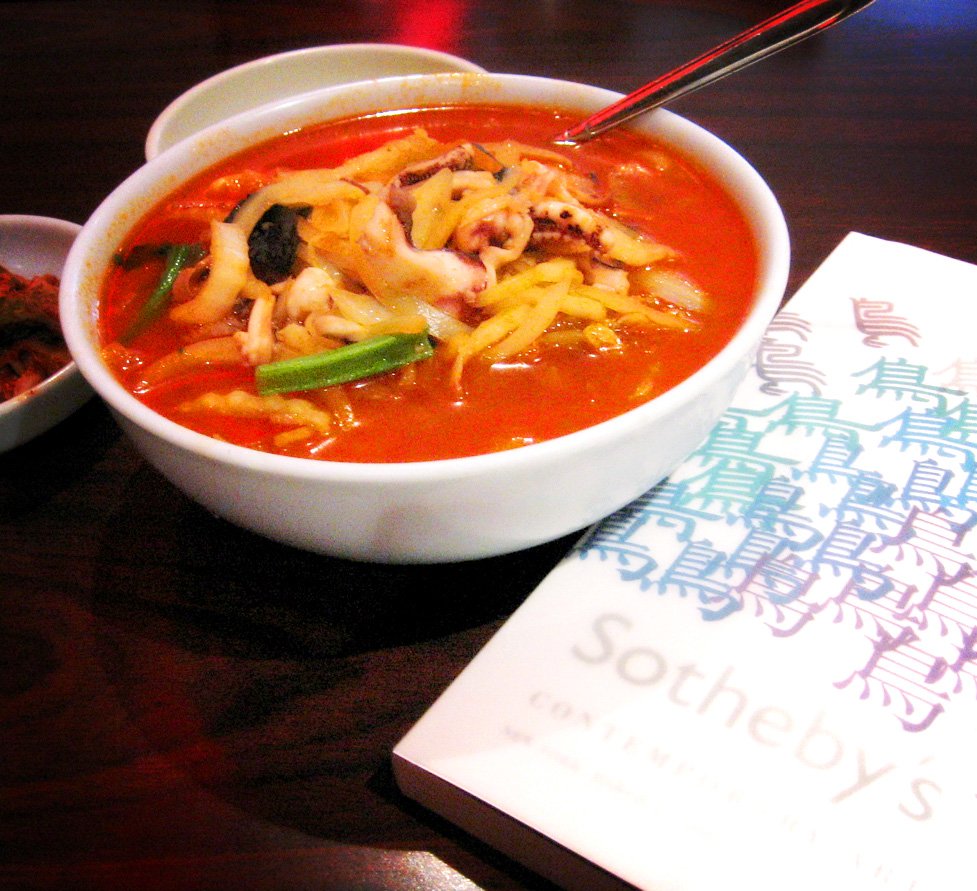
Jjamppong is a Korean-Chinese noodle soup built on a fiery red, chili-oil-based broth loaded with squid, mussels, shrimp, and vegetables. It belongs to junghwa yori (중화요리), the Chinese-Korean cuisine served at Chinese restaurants across Korea, and sits alongside jjajangmyeon as one of the two most-ordered dishes at any such restaurant.
Where jjamppong actually comes from
Jjamppong did not arrive in Korea as a finished Chinese dish. Its roots trace to Shandong Chinese immigrants who settled in Incheon after the port opened to foreign trade in 1883 and after the Imo Incident of 1882, when Qing troops and merchants began arriving in large numbers. Incheon’s Chinatown, built around this community, is also where jjajangmyeon took shape. Jjamppong grew out of the same neighborhood but has no single claimed inventor the way jjajangmyeon does.
The dish these immigrants served first was a milder, white-broth noodle soup. Japanese colonial-era observers in Korea noticed the broth resembled a dish from their own country, champon, and the name stuck: the Japanese word was adapted phonetically into Korean as jjamppong.
That Japanese dish, champon, has its own documented origin. It was created in Nagasaki around 1899 by Chen Ping Shun, a Chinese immigrant from Fuqing in Fujian province, at the restaurant Shikairo. Shikairo’s own account traces champon to a Fujianese noodle dish, though food historians have raised doubts about exactly which regional dish it descended from. Champon became a signature Nagasaki specialty in its own right and spread from there into the wider vocabulary of Chinese-Japanese cooking, which is the route by which the name reached Korea.
So jjamppong’s lineage runs through two separate adaptations: a Fujianese-style noodle soup became champon in Meiji-era Nagasaki, and a related white noodle soup served by Shandong immigrants in Incheon picked up the same name under Japanese colonial rule, before Korean cooks and customers reworked it into something distinct.
- Korean name
- 짬뽕 (jjamppong)
- Cuisine
- Korean-Chinese (중화요리, junghwa yori)
- Main components
- Thick wheat noodles, red chili broth, squid, mussels, shrimp, vegetables
- Origin
- Incheon Chinatown, developed by the Shandong Chinese immigrant community
- Heat source
- Gochugaru and chili oil, added by Korean cooks and diners from the 1960s-70s onward
- Related dishes
- Jjajangmyeon (black bean noodles); Japanese champon (milder ancestor dish)
How it turned red
For decades after it arrived, jjamppong stayed a white or light broth, closer to its Chinese and Japanese relatives. One account traces the shift to the 1960s: diners began adding their own red pepper powder to the soup at the table, and when pepper prices spiked, restaurant owners started stirring chili oil directly into the broth instead of relying on customers to season it themselves. Other food writers place the fully red, standardized version slightly later, with documented examples by the early 1970s. Either way, the move to gochugaru and chili oil was a Korean customer-driven change, not something imported from China or Japan, and it is what gives modern jjamppong its identity.
Jjamppong vs. jjajangmyeon vs. Japanese champon
The three dishes share a family tree but taste nothing alike. Jjajangmyeon, Incheon Chinatown’s other signature export, is wheat noodles tossed in a thick, near-black sauce made from fermented black soybean paste, onions, and usually pork or seafood; it is savory and slightly sweet, with no real heat. Jjamppong is its opposite number: a soupy, chili-red, seafood-forward broth meant to be eaten hot and spicy, closer in spirit to a stew than to a saucy noodle dish.
Japanese champon, by contrast, has stayed closer to its original form: a milder, often pork-bone or chicken-based broth with thick noodles, vegetables, and seafood or pork, without the chili. It remains a specialty of Nagasaki today, served without the gochugaru that defines its Korean cousin. The easiest way to remember the split: champon is the quieter original, jjamppong is the Koreanized, spiced-up version that took on a life of its own.
The broth, the seafood, and the vegetables
A jjamppong broth starts with aromatics, usually onion and garlic, stir-fried hard in oil along with gochugaru so the chili flavors the fat before any liquid goes in. Cabbage, Korean zucchini, carrots, and other vegetables go in next, followed by the seafood, commonly squid, mussels, and shrimp, sometimes with pork added for depth. Stock is added and the pot is simmered until the broth turns a deep orange-red and the noodles, usually thick wheat noodles similar to those used in jjajangmyeon, are cooked in or alongside it. The result is a broth that is spicy, briny from the shellfish, and noticeably oilier than a plain seafood soup, because the chili oil built at the start carries through the whole bowl.
Variants worth knowing
A few versions show up regularly on Korean-Chinese menus. Samseon jjamppong (“three delicacies”) is a premium version loaded with a wider range of seafood than the standard bowl, usually priced higher accordingly. Gul jjamppong swaps in oysters and is often served in a spicy white broth rather than the usual red, a style also associated with older restaurants that never fully switched to the red version. More recently, some restaurants have introduced cream jjamppong, which adds a whipped cream sauce to the broth for a sweeter, buttery finish while keeping some of the chili heat underneath, a newer, fusion-leaning take rather than a traditional one.
The jjajangmyeon-or-jjamppong dilemma
Choosing between jjajangmyeon and jjamppong is such a common sticking point at Korean-Chinese restaurants that it has its own name and its own solution. The indecision is widely enough recognized that restaurants created jjamjjamyeon (짬짜면), a single dish split down the middle, half jjajangmyeon and half jjamppong, so diners do not have to pick one. The dilemma has also shown up in Korean pop culture, including a K-drama storyline built around the rivalry between the two dishes. For a broader sense of where these dishes fit in Korean cuisine generally, see this site’s overview of Korean food culture.
That rivalry, and the restaurants built around it, are part of why Korean-Chinese cuisine remains its own category rather than a subset of Chinese food in Korea. Jjamppong and jjajangmyeon are treated as Korean dishes with Chinese immigrant roots, served at specialized Chinese restaurants, and ordered as a pair or debated as a choice almost every time someone eats at one.
More Korean food on this site: jjajangmyeon, the black bean noodles jjamppong is always compared against, and kimchi jjigae, for another red, spicy Korean broth.