
Korean food
Samgyeopsal: Korea’s Grilled Pork Belly Explained
삼겹살 · samgyeopsal
Samgyeopsal is Korea's unmarinated grilled pork belly, thick-sliced, cooked tableside, and wrapped in lettuce with ssamjang. Born from postwar scarcity and a 1970s pork oversupply, it became the country's defining soju pairing and, by some counts, its most popular dish among non-Koreans.
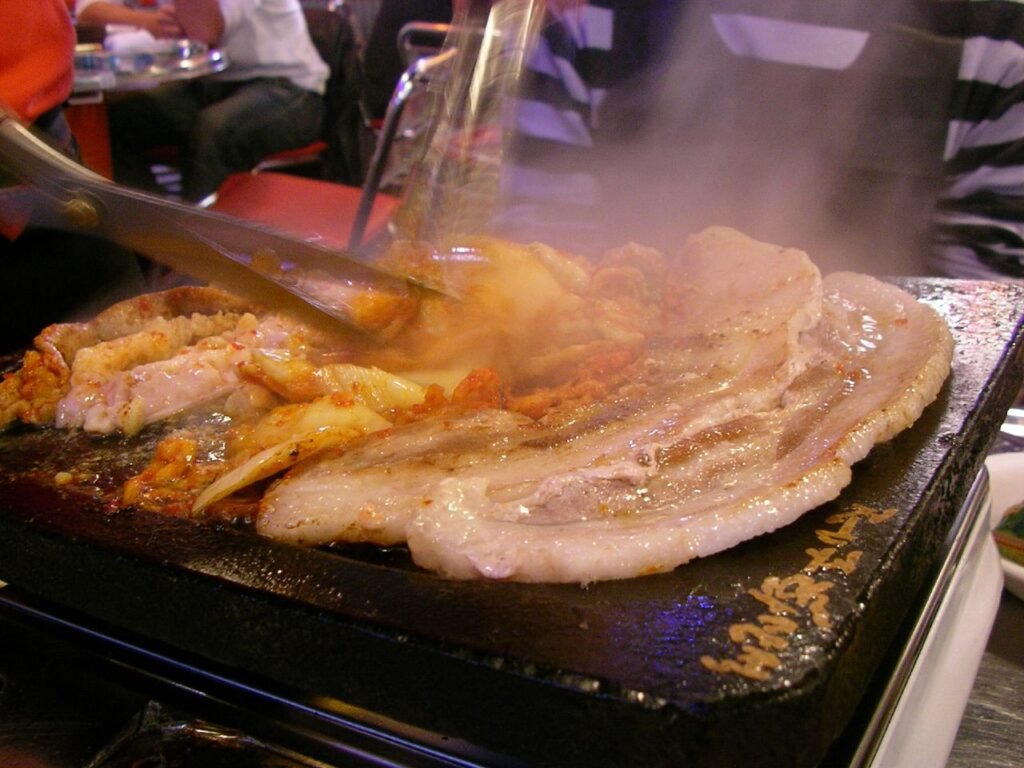
Samgyeopsal is Korean grilled pork belly, thick-sliced and left unseasoned, cooked tableside on a dome-shaped or flat grill and eaten wrapped in lettuce or perilla leaves with ssamjang. The name literally means “three-layer flesh,” describing the bands of fat and meat visible in every slice.
The cut: pork belly, unseasoned and thick
Samgyeopsal comes from the pig’s belly, the section running from roughly the fifth or sixth rib back toward the hind leg. The skin is removed before cooking, which is one way it differs from ogyeopsal, a related cut that keeps the skin on and is named for having five layers instead of three. Unlike bulgogi or galbi, samgyeopsal is traditionally served plain, with no marinade, so the taste of the pork and the render of its fat are the point. Marinated versions, in wine, ginseng, doenjang, gochujang, curry or herbs, became common only from the late 2000s onward, long after the plain version was already a national staple.
The slices are thick, usually around a centimeter, thick enough that they need real time on the grill and get cut into smaller pieces with scissors once cooked through. Thinner variations exist too: daepae samgyeopsal, a thinly sliced style, was invented in 1996, and beoljip samgyeopsal, cut in a honeycomb pattern to cook faster and render more fat, showed up in the 2000s.
- Korean name
- 삼겹살 (samgyeopsal)
- Literal meaning
- "Three-layer flesh," for the bands of fat and meat in the cut
- Main protein
- Pork belly, skin removed, sliced about 1 cm thick
- Cooking method
- Grilled tableside by diners, unmarinated
- Eaten with
- Lettuce or perilla leaf, ssamjang, garlic, banchan, soju
- Related dish
- Ogyeopsal (skin-on, five-layer variant); bossam (boiled pork belly wraps)
How it’s cooked at the table
Samgyeopsal is almost never finished in a kitchen and brought out ready to eat. It’s grilled at the table, on a slanted metal griddle or a gridiron set over charcoal or a gas burner built into the table itself, and diners cook it themselves, flipping the strips with tongs and snipping them into bite-sized pieces with kitchen scissors as they go. Some restaurants now use okdol pebble grills, jade-flecked stone surfaces that give off far-infrared heat, a more recent twist on the same basic setup.
The ssam wrap and what comes with it
Once a piece is cooked through, it goes onto a lettuce or perilla leaf with a dab of ssamjang, the thick, savory-spicy soybean paste made for this exact purpose, then gets folded into a single bite called ssam. Garlic slices, green chilies and onion go in the wrap too, often grilled alongside the meat on the same surface. A full samgyeopsal spread brings a wide ring of banchan around the grill: kimchi, pickled radish, seasoned bean sprouts, a simple soup, jangajji (vegetables pickled in soy sauce), and a second sauce, gireum-jang, made from sesame oil, salt and pepper for diners who want something lighter than ssamjang.
Anju: why it’s soju’s favorite partner
Samgyeopsal is one of Korea’s defining anju, food meant to be eaten alongside alcohol, and specifically alongside soju. Pork belly became soju’s companion of choice in the early 1980s, turning barbecue into an everyday social ritual at restaurants, at home and even on mountain hikes. The combination is common enough that it has its own portmanteau drink, somaek, soju mixed with beer, poured to go with the meat. The pairing also became tied to hoesik, the after-work group dinners common at Korean companies, which did as much as anything to cement samgyeopsal’s status as an everyday, communal dish rather than an occasional treat.
Where the name and the dish came from
The name breaks down cleanly: sam means three, gyeop means layer, and sal means flesh, together describing the alternating bands of lean and fat in the cut. But the dish as Koreans eat it today is newer than the name might suggest. Research from food historian Joo Young-ha traces grilled pork’s rise to the aftermath of the Korean War, when people without reliable refrigeration had to cook and eat meat immediately rather than store it, and to the 1960s and 1970s, when briquette fuel and repurposed steel drums, some from U.S. military bases, made tabletop grilling widely accessible for the first time. Koreans had historically favored beef, and pork carried negative health associations into the early 1970s; pork consumption only took off after a 1977 export slump to Japan left Korea with a domestic oversupply of belly meat and falling prices. The first documented newspaper mention of the dish, then spelled “segyeopsal,” appeared in The Dong-A Ilbo on November 3, 1984, and the word entered the Standard Korean Language Dictionary after 1994. Meat consumption in Korea rose roughly tenfold between 1970 and 2016, from 5.2 to 55.9 kilograms per person annually, and pork belly rode a large share of that increase. By the 1997 IMF financial crisis, its affordability made it the default barbecue order for a country tightening its budget, and a period survey found 66.7 percent of all pork purchases were belly cuts specifically.
Samgyeopsal Day and its popularity today
March 3rd is marked informally in Korea as Samgyeopsal Day, a date chosen because “3/3” echoes the “sam,” or three, in the dish’s name. It wasn’t a folk tradition that grew up on its own: the Paju Yeoncheon Livestock Corporation created it in 2003 as a marketing push for pork sales, and it has stuck around since as an actual, if unofficial, tradition that restaurants and grocers still use to run pork specials every year. A 2006 survey found 85 percent of South Korean adults named pork belly their favorite cut of pork, and by 2019 a Korean Food Promotion Institute survey had samgyeopsal ranked as the favorite Korean dish among non-Koreans, a sign of how far the dish has traveled since its working-class, postwar beginnings. Rising demand and food inflation have more recently earned it a half-joking nickname, geum-gyeopsal, or “gold pork belly,” for how much prices have climbed.
More Korean food on this site: for the other great way to eat pork belly, try bossam, Korea’s boiled and wrapped pork belly dish, or pair any of it with a guide to soju, the drink samgyeopsal was practically made for.